An academic essay is a formal piece of writing used in higher education to present, analyze, and defend an argument using evidence and logical reasoning. An academic essay is a structured, evidence-based piece of writing designed to present and define an argument or idea using credible sources and logical reasoning.
Students frequently struggle with these essays because they must balance critical thinking, research, formal writing conventions, and proper citation skills that contribute substantially to overall course assessment in many universities. The following key points to be remember:
- It requires clear structure, critical thinking, and credible sources.
- Academic essays are used to assess understanding, analysis, and communication skills.
- Most essays follow a clear introduction–body–conclusion structure.
- Strong essay writing skills improve academic performance and readiness for advanced study.
What Is an Academic Essay?
An academic essay demonstrates a student’s ability to develop a clear thesis, support it with credible academic sources, and critically engage with ideas through analysis and argumentation.
This purpose distinguishes academic essays from personal or narrative pieces, emphasizing scholarly communication and intellectual contribution rather than personal opinion or storytelling.
Definition and Purpose in Academia
An academic essay is a formal written piece of paper explains a topic while demonstrating scholarly reasoning and use of credible sources.
It is designed to present a reasoned argument supported by credible sources, demonstrating the writer’s understanding and engagement with the subject matter. A
Key Characteristics of Academic Essays
Academic essays are distinguished by several core features:
- Formal and objective tone: They avoid casual language and personal opinion unsupported by evidence.
- Evidence-based arguments: Every claim or assertion should be supported by data, research findings, or authoritative sources.
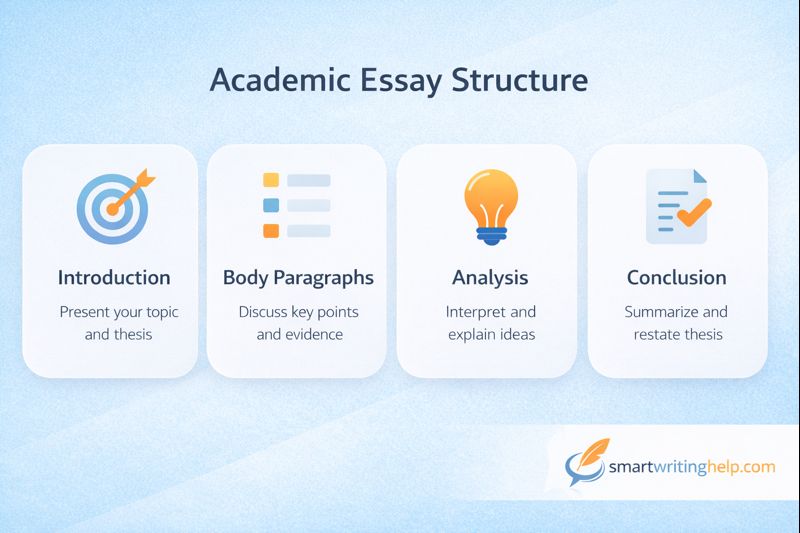
- Structured organization: Academic essays typically follow the introduction → body → conclusion format, allowing ideas to develop logically.
- Clear thesis and logical flow: Every paragraph should relate back to the thesis and contribute to the overall argument.
Difference Between Academic and Informal Writing
Unlike personal or informal writing, academic essays priorities analytical depth, critical engagement, and formal conventions. Rather than telling a narrative or offering unsubstantiated opinions, they ask the writer to engage with evidence, interpret data, and situate arguments within broader scholarly discourse.
Their formal structure, emphasis on reasoning, and consistent use of citations distinguish them from journalistic, creative, or casual writing genres.
Common Types of Academic Essays (Argumentative, Expository, Critical)
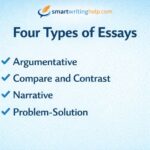
Academic essays can take several forms depending on their core purpose:
- Argumentative essays present a clear position on a debatable issue and support it with evidence and logical reasoning.
- Expository essays explain or clarify a topic in a structured, objective way, often involving definitions, classifications, or comparisons.
- Critical essays evaluate ideas, arguments, or works by interpreting evidence, analyzing strengths and weaknesses, and drawing nuanced conclusions.
Each type follows the basic essay structure — introduction with thesis, body paragraphs with evidence and analysis, and conclusion but the focus of reasoning and the role of evidence differ slightly according to the essay’s intention.
Why Academic Essays Matter for Students
Academic essays play a central role in higher education by assessing students’ understanding of subject matter, their ability to construct logical arguments, and their competence in academic writing. They require students to move beyond surface learning and demonstrate analysis, reasoning, and structured communication.
i- Academic Assessment and Grading
Academic essays are a major part of how students are assessed in schools and universities. Teachers use essays to check whether students understand key ideas, can organize information logically, and can support their points with evidence.
Because essays require more than remembering facts, they are often weighted heavily in grading, meaning good essay skills can directly improve overall academic performance.
Writing essays helps students show what they know in a structured way, which allows educators to judge learning and comprehension more fairly than multiple-choice tests. This type of assessment also reveals how well students can research, analyze, and communicate ideas
ii- Critical Thinking and Communication Skills
Academic essays strengthen critical thinking by training students to question ideas, evaluate evidence, and develop independent arguments rather than simply recalling information.
Through essay writing, students learn how to analyse complex topics, compare perspectives, and draw reasoned conclusions based on evidence.
At the same time, essays improve communication skills by requiring clear structure, precise language, and logical flow, helping students express complex ideas in an organised and persuasive manner.
Academic essays prepare students for the workplace by building skills that employers value, such as the ability to research, analyse information, write clearly, and think independently.
iii- Academic Essays and Career Readiness — keyword relevance
These competencies are similar to tasks professionals perform when writing reports, proposals, or project summaries. Writing essays teaches students to work through complex topics step by step and explain solutions in clear, organised language.
Because critical thinking and communication are essential for most careers, strong essay skills help students move more confidently from education into jobs or graduate programs.
iv- Understanding Essay Prompt and Assignment Requirements
When you first receive an essay prompt, take a moment to read it slowly so you really know what the assignment is asking. Understanding the task early helps you focus your research and organise your thoughts in the right direction.
Looking closely at the instructions and phrasing makes writing easier because you already know what the teacher expects by the time you begin.
How to Read and Interpret Essay Questions
Start by reading the essay question more than once so the meaning becomes clear in your mind. Notice any action words like define, compare, or discuss because these tell you what you must do with the topic.
Try to write essay topic relevant questions whatever comes to your mind in your own words before you begin planning your essay. This can help you see whether you need to explain a concept, give reasons, or explore ideas more deeply.
a)- Identifying Scope, Keywords, and Restrictions
Look for academic phrases that narrow down the subject or limit what you should cover, so you don’t go too broad. Words like only, in the context of, or up to help set these limits and stop your essay from becoming too general.
Pick out key terms that show the main idea you must address and keep them in mind as you write. These keywords will guide your research and help you stay focused on the exact task you were given.
b)- Avoiding Common Prompt Misinterpretation Errorsb)-
A common mistake is to overlook the prompt and jump into writing without fully grasping what is asked. This can lead to answering a different question or including irrelevant points in your essay.
Another error is assuming you know what a word means when the prompt expects you to explain or interpret it in a specific way. If you are unsure, read around the term or ask for clarification before you start writing.
Once the essay prompt and requirements are clearly understood, the next step is to follow a structured writing process that transforms ideas and research into a coherent academic essay.
Steps Involved in Writing an Academic Essay
Step 1 — Research and Gathering Sources
The steps involved in writing an academic essay include planning, researching, drafting, revising, and refining ideas into a clear, well-structured argument. This stage involves finding reliable material, choosing the right places to look, and organising what you learn so you can use it clearly in your essay.
i- Finding Credible Academic Sources
When you gather good sources, you are collecting the evidence and facts that support your points. Taking clear notes and keeping track of where each idea comes from saves time later when you begin writing.
Start by looking for information that is relevant to your topic from reliable places such as books, scholarly articles, and respected journals. These sources should feel trustworthy and directly related to what you need to explain or argue in your essay.
Some academic databases offer large collections of research material your library might give you access to, and they are often a better starting point than a generic internet search.
ii- Library vs Online Scholarly Databases
Another part of research is deciding where to look. Libraries give access to many books and printed journals that might not show up in a regular web search, while online scholarly databases focus on academic papers and articles you can use for essays.
Using both gives you a broader range of material to work with. For example, looking up research on adolescent psychology in both books and online journals gives you both background and up-to-date studies to reference.
iii- Note-Taking and Reference Tracking
As you read through your sources, make clear notes that include important ideas, quotes, and facts you might use later. Record details like the title, author, and page numbers with each note so you can remember where each piece of information came from when you write your essay.
This organised approach helps you focus on the argument you are building rather than losing track of your research.
By combining careful selection of credible material with good note-taking and organisation, you make the rest of the essay writing process much easier and more effective.
Step 2 — Planning and Outlining Your Essay
Planning and outlining your essay gives you a clear path before you start writing. It helps you see all your ideas in order and sets the stage for writing with confidence and flow.
A good plan saves time later because you already know what goes where, and it makes your essay easier to follow from introduction to conclusion.
i- Creating a Logical Essay Map
At the heart of planning is creating a logical map of your ideas and shaping your thesis so you know what you want to say. This early thinking helps you organise your arguments and decide how each paragraph will support your main point. Seeing the order of ideas before writing makes the whole process smoother.
ii- Thesis Statement Development
A thesis statement in an academic essay is a clear, focused sentence that presents the main argument and guides the direction of the entire paper.
iii- Sample Academic Essay Outline Template
In practice, a simple outline might begin with an introduction that includes your main claim, followed by body sections that develop each key idea, and end with a conclusion that brings everything together.
For example, if you are writing about how technology affects learning, you might plan one section about tools that help focus, another about tools that distract, and a final part comparing both before finishing with your view on the topic.
Step 3 — Writing the Introduction
Writing the introduction is about making your reader ready for the essay and giving them a clear idea of what you will discuss. A good introduction catches attention, gives some background, and ends with your main point so readers know what to expect.
Getting the introduction right makes the rest of your essay easier to follow because readers understand your topic and your focus before you go into detailed points.
i- Hook, Context, and Thesis Placement
The first sentence of your introduction should grab the reader’s interest and lead into the topic, such as an interesting fact or a question that makes the topic feel important.
After that, a couple of sentences provide the background or context so readers understand why the topic matters and what you will focus on. The final sentence of the introduction is where you place your main idea, called the thesis, which tells the reader what you will argue or explain.
A good introduction starts with something that makes someone want to read more, moves smoothly to the general topic, and ends with the clear statement that guides the rest of the essay.
ii- What a Strong Thesis Looks Like
A strong thesis is a clear sentence near the end of your introduction that explains the central point you will make in your essay. It should be specific, showing both the topic and the position or idea you are taking, so readers can follow your reasoning as they read on.
For example, a thesis about study habits might say that setting a consistent daily schedule helps students learn better because it reduces stress, improves focus, and builds good routines. This tells the reader what the essay will explain and why it matters.
iii- Example Introduction Paragraph
Consider an essay that examines the importance of recycling. Your introduction might begin with a sentence that makes the reader think, include a few lines that explain why waste is a growing concern, and finish with a thesis that states your main idea.
For example, you might start with a striking point about how much waste cities produce, explain that recycling programs can reduce that waste and protect the environment. You should end with a clear statement that recycling should be expanded in local communities to improve sustainability and reduce pollution.
This type of introduction draws attention, offers context, and shows your main point before the essay moves to detailed support.
Step 4 — Writing the Body Paragraphs
Body paragraphs are where you develop and explain the main points of your essay. Each paragraph focuses on one idea and shows how it supports your main argument, helping the reader follow your reasoning from start to finish.
Writing clear and connected paragraphs also makes your essay feel smooth and easy to follow. A strong body section lets readers see why your ideas matter and how they work together.
i- Topic Sentences That Support the Thesis
A topic sentence is the first line of a body paragraph that tells the reader what that paragraph will be about and how it connects to your main idea. It acts like a mini-map, showing the main point before you explain it further.
A clear topic sentence keeps the paragraph focused and helps your reader understand how your ideas build on your thesis.
ii- Evidence, Analysis, and Interpretation
After the topic sentence, you add evidence, such as facts, examples, or details that back up your point. Then you explain how this evidence connects to your topic sentence and why it matters.
This part of the paragraph shows your thinking, not just what the evidence says, and helps the reader see why your point is true.
For example, if your essay is about the benefits of reading, you might include a study showing that reading improves memory and then explain how that supports your argument that regular reading strengthens the mind.
iii- Address Challenges and Answers
Sometimes it helps to mention a different or opposing view to show you have thought about other ideas. A counter-argument is a point that challenges your idea, and a rebuttal is your explanation of why that challenge does not weaken your thesis.
Addressing both strengthens your essay by showing you understand the topic from more than one angle.
iv- Transitions for Coherent Flow
Transitions are short phrases or sentences that link one paragraph to the next so your essay does not feel choppy. They help the reader move smoothly between ideas by showing how one point connects to the next.
Good transitions often refer back to something you just wrote or hint at what comes next, making the flow of your essay feel natural and easy to follow.
Step 5 — Conclusion That Leaves an Impact
A good conclusion brings your essay to a satisfying close by showing the reader why your ideas matter and tying everything together. It should remind the reader of your main point and leave them thinking about your topic even after they finish reading.
A strong ending helps your essay feel complete without adding new arguments or facts, and it gives your reader a sense of closure and purpose.
i- Summarizing Key Ideas
In the conclusion, briefly bring back your most important points from the body of the essay to show how they connect to your main idea. Rather than repeating details one by one, show how the points work together to support your overall argument.
This helps the reader see the logic of your essay as a whole and reinforces the message you have spent the paper explaining.
ii- Restating the Thesis with Insight
You should restate your thesis in new words to remind the reader of your central claim, but also show how your essay has developed that idea.
This means echoing your main argument with a fresh phrase that reflects what the body paragraphs have shown.
By doing this, your conclusion feels intentional and thoughtful instead of just a copy of the introduction.
iii- Ending With Future Implications or a Call to Thought
A strong conclusion often goes a step further by showing why your topic matters beyond the essay itself. You might connect the ideas to a larger question or point out what readers should consider next.
For example, if your essay argued that healthy eating improves student focus, the ending could suggest how schools and families might encourage better habits to support learning in the future.
Academic Style, Tone, and Language
Academic style is a way of writing that helps your ideas come across clearly and professionally. It keeps your language steady and focused, so people reading your essay can understand your points without getting distracted by casual words or phrases.
This style also shows your respect for the topic and makes your writing feel credible and serious.
Good academic tone and language help you communicate complex ideas in a way that feels calm, clear, and fair. When you write in this way, your reader can follow your logic from one point to the next without confusion.
Formal Academic Language Rules
Formal academic language means using clear, precise words and complete sentences. You avoid casual expressions, slang, or shortened words like do not say “can’t” or “don’t” and instead use “cannot” and “do not” so your writing sounds more professional.
It often uses the third person rather than saying “I think” so your argument feels based on evidence, not personal opinion. For example, instead of writing “I believe this method works best,” you might write “This method appears to be the most effective,” which sounds more measured and formal.
a)- Avoiding Bias and Informal Tone
To avoid bias and informal tone, you should use neutral and objective language that does not favour one view without evidence. This means steering clear of emotional words like “terrible” or “amazing” and not writing in a way that seems to push your personal feelings.
Instead, explain the evidence and let the facts speak for your ideas, which helps your reader see your argument as balanced and fair.
b)- Grammar and Academic Conventions
Grammar and conventions in academic writing are about using correct sentence structure, punctuation, and spelling so your ideas make sense and read smoothly.
You also follow consistent rules about things like how to show quotes, how to refer to people or studies, and how to write numbers or specialised terms so your essay looks organised and professional.
Paying attention to these conventions helps your work feel polished and easier for others to understand.
Common Academic Essay Mistakes Students Make
- Misinterpreting the essay prompt: Writing without fully understanding task words such as analyse, discuss, or evaluate often leads to irrelevant answers.
- Weak or unclear thesis statements: Essays without a precise central argument lack direction and coherence.
- Descriptive writing instead of analysis: Simply summarising information without explaining its significance weakens academic quality.
- Poor paragraph structure: Paragraphs that lack topic sentences or logical flow confuse readers and dilute arguments.
- Incorrect or missing citations: Failing to reference sources properly can result in plagiarism and loss of academic credibility.
Common Essay Structures and Models
Understanding different ways to organise an essay helps you choose the best shape for your ideas. Some models make writing easier when you are first starting, while others let you expand on more complex topics and arguments.
Using a structure gives your writing a clear beginning, middle, and end, and helps your reader follow your reasoning. Knowing several structures also makes it easier to adapt your essay to different assignment types.
1- Narrow to Wide Structure
The narrow-wide structure starts with a broad introduction and gradually narrows to focus on your specific main idea, then widens again in the conclusion to connect that idea to a bigger picture.
This helps the reader see how your detailed point fits into a larger context instead of just standing alone. It often feels natural because you begin with general information, move to a focused discussion, and then step back to show why it all matters.
2- Five-Paragraph Essay Model
The five-paragraph model is a simple and common way to organise an essay with one introduction, three body paragraphs, and one conclusion.
Each body paragraph focuses on a key point that supports your main idea, making it easy to plan and write especially for shorter assignments or under timed conditions. Many students learn this model first because it teaches clear order and development of ideas before moving to more flexible formats.
3- Alternative Structures (Problem-Solution, Thematic) — adds search relevance
Beyond basic formats, essays can follow structures like problem-solution or thematic organisation depending on the task. In a problem-solution structure, the essay describes an issue.
It discusses ways to address it, which works well when the assignment asks you to analyse causes and suggest improvements. A thematic structure groups ideas around themes or topics, which helps when you need to explore different aspects of a subject in depth.
Comparison of Common Essay Structures
The following table compares common academic essay structures, highlighting how each format is organised and when it is most appropriate to use. Understanding these differences helps students choose a structure that best fits their assignment requirements.
| Structure | Main Focus | How It’s Arranged | When to Use |
| Hourglass Structure | Starts broad, narrows, then broadens again | Begins with a general introduction, focuses tightly in the body, then connects back to bigger ideas in the conclusion | Good when you want to show how specific points fit a larger topic |
| Five-Paragraph Essay | Simple organised argument | One intro, three body paragraphs, and one conclusion | Helpful for short essays or timed writing where clarity matters |
| Problem-Solution Structure | Shows an issue then suggests how to fix it | Introduces a problem, explores it, then presents one or more solutions before closing | Useful when the question asks you to analyse a problem and propose answers |
Editing, Proofreading, and Revision Strategies
Editing, proofreading, and revising are the final steps that help your essay become clear, correct, and easy to read.
These steps give you a chance to improve what you wrote, fix mistakes, and make sure your ideas are expressed in the best way possible. Taking time to do this well makes your work stronger and more confident.
Good revision means looking at both the big picture of your writing and the small details that affect how the reader understands your message. A careful review can catch issues that were missed during writing.
Self-Editing Checklist
When you edit your essay yourself, it helps to have a list of questions or points you check in each draft. Start by reading your essay slowly from start to finish with fresh eyes so you spot sentences that are hard to follow or points that don’t connect well.
Then check simple things like spelling, punctuation, and whether each sentence clearly says what you want it to say.
Going through your essay in parts — first for errors in content and organisation, then for sentence clarity — makes it easier to notice small problems you may have missed while writing.
Peer Review Techniques
Getting a friend or classmate to read your essay can give you a new perspective on your writing. A peer can point out places where your ideas feel unclear or where your paragraphs need better transitions.
When someone else asks questions about your points or suggests clearer wording, you can revise with more confidence.
A helpful way to give feedback is for both readers to take turns: one reads the other’s work, gives comments, then switches. This makes the review a cooperative process where both people learn from each other.
Tools for Grammar, Plagiarism, and Style
Using a tool to check writing style or patterns can also help you see where sentences are long or confusing and need to be rewritten so your essay reads more smoothly. These tools work best when you use them carefully and then make your own decisions about your writing
Citation and Academic Integrity
Citation and academic integrity are about giving credit where it is due so your essay reflects honest work and respect for the ideas you use.
When you show where your information comes from, you protect your own credibility and make it clear to your reader how your points are supported. This also helps you avoid problems like unintentional copying, which can lead to serious consequences in school.
Understanding how to reference correctly and follow the rules of academic honesty gives you confidence in your writing and shows you are part of a community that values fairness and accuracy.
Importance of Proper Referencing
Proper referencing means you clearly show where each idea or fact in your essay came from, whether you quote a sentence, summarise someone’s view, or use data to support your argument.
This matters because it shows you have done your research and allows your reader to check the original work if they want. When you forget to reference a source, it can look like you are using someone else’s ideas as your own, which is unfair and can be flagged as plagiarism.
If you face trouble knowing how to reference, start by writing down the author and title of each source as you read it so you do not forget the details later. This simple habit saves time and prevents mistakes.
In Text Citations vs Bibliography
In-text citations are small notes inside your essay that tell the reader a specific source was used right there, usually with an author’s name and a page number or year. These help your reader see exactly where a piece of information came from without flipping to the end right away.
A bibliography, or references list, comes at the end of your essay and shows full details for every source you cited so someone could find it for themselves.
For example, in many styles you might show the author and year next to a quoted idea inside brackets, then list full details like author, title, and publication information in the reference section at the end.
Common Citation Styles (APA, MLA, Chicago)
There are several systems for how you format citations and lists of sources, and three of the most widely used are APA, MLA, and Chicago.
APA is often used in the social sciences and focuses on author and year of publication, helping readers see how recent the research is. MLA is common in language and literature subjects and usually includes author and page number in citations. Chicago style can use numbered notes at the bottom of the page or author-date references, and it is often used in history and the arts.
Because each style has its own rules for how to list names, dates, titles, and pages, it is important to choose one and use it the same way throughout your essay so your writing stays clear and consistent.
Citation Examples of Various Source Types
Useful Academic Writing Tools and Templates
Writing and organising an academic essay is easier with the right tools that help you manage sources, plan your ideas, and polish your drafts.
These tools range from software that handles citations to products that help you sketch out your structure and improve your writing clarity. Using even one or two of these can save time and make your work feel more organised and professional.
Citation Generator Tools
Citation managers help you keep track of all the books, articles, and web pages you use in your research. Tools like Zotero let you save research items with one click and then automatically format in-text citations and bibliographies, so you spend less time typing references and more time on your writing.
Another example is JabRef, which is especially useful if you work with LaTeX and want to organise bibliographic entries neatly. These managers organise sources in one place so you don’t lose track of them as your research grows.
Outlining and Mind-Mapping Tools
Outlining and mind-mapping tools let you sketch the structure of your essay before you write it, helping you see how ideas connect. Mindomo, for instance, lets you create visual diagrams of your main points and how they branch into supporting ideas.
Another option many students use for brainstorming and planning is Coggle, which works well when you want to visually organise your thoughts before starting a full outline. These visual tools make it easier to move from a vague idea to a clear plan for your essay.
Revision and Editing Tools
Editing tools can assist with identifying grammar, spelling, and clarity issues during revision, but they should be used as a support rather than a substitute for careful self-editing.
Students should review all suggestions critically to ensure accuracy, consistency with academic tone, and alignment with assignment requirements.
Conclusion
Mastering academic essay writing is not only about following a structure but about developing the ability to think critically, engage with evidence, and communicate ideas with clarity and precision.
By understanding essay requirements, applying a systematic writing process, and refining work through careful revision, students can produce essays that meet academic standards and perform strongly in assessment.
These skills extend beyond university assignments, supporting advanced study, research, and professional communication.
Frequently Asked Questions
How long should an academic essay be for university students?
The length of an academic essay depends on the assignment level and requirements, but it typically ranges from 300–500 words for basic tasks to 1,000–3,000 words for university-level essays.
How do I choose a topic for an academic essay?
Choose a topic that directly addresses the assignment question, is narrow enough to analyse clearly, and has sufficient academic sources to support your argument.
What are the most common academic essay mistakes students should avoid?
Common mistakes include misinterpreting the essay prompt, writing descriptively instead of analytically, using weak or unsupported arguments, and failing to reference sources correctly.