A compare and contrast essay explores the similarities and differences between two subjects to reveal deeper insights. It goes beyond listing facts, helping readers understand relationships and make meaningful connections.
Key points about a compare and contrast essay:
- Analyzing two subjects for similarities and differences
- Using a clear thesis to guide the reader
- Organizing ideas logically for easy understanding
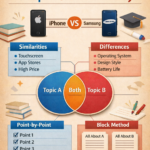
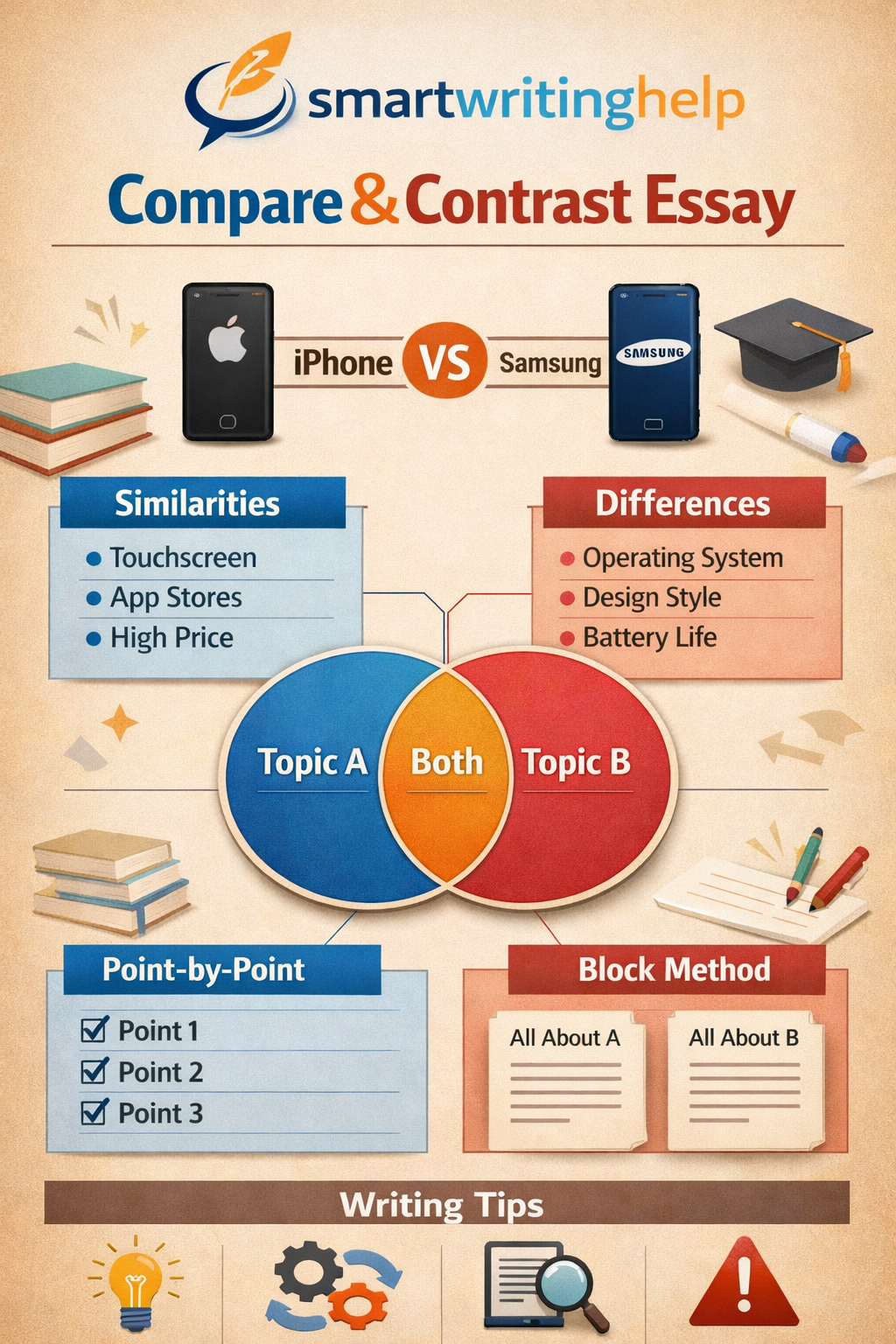
For example, comparing iPhone and Samsung phones can show how design, performance, and price affect user experience, rather than just listing features.
The Structure of a Compare/Contrast Essay
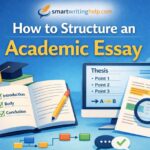
A strong compare and contrast essay starts with a clear thesis that identifies the subjects and explains why the comparison or contrast matters. The thesis guides the reader and sets up the purpose of the essay. For example, you might argue that organic vegetables cost more than conventional ones but offer better nutritional value, giving your essay a clear focus.
There are two main ways to organize the body of a compare and contrast essay:
- By subjects: Discuss one subject fully before moving to the other.
- By points: Compare each subject based on specific traits or criteria.
Choosing the right structure depends on your audience, the nature of your subjects, and what you want the reader to learn. Using phrases of comparison and contrast, like “similarly” or “in contrast,” helps make the relationships between ideas clear. This approach keeps the essay focused, engaging, and easy to follow.
1-Thesis Statement
The thesis statement is the base of a compare and contrast essay. It clearly states the subjects and highlights what the reader will learn from the analysis. A strong thesis not only names the two items being compared or contrasted but also makes a claim that guides the essay.
For example, a thesis could state that electric cars are more environmentally friendly than gasoline cars, but gasoline cars remain more affordable and accessible. This sets up a clear path for exploring both similarities and differences in the essay.
A focused thesis ensures the essay stays organized and keeps the reader engaged, showing why the comparison or contrast is meaningful.
2-Organizational Strategies
A well-structured compare and contrast essay depends on the way you organize your subjects and points. One approach is by subjects, where you discuss all aspects of the first subject before moving to the second. This method works best when each subject has distinct qualities and requires a complete, separate analysis.
The second approach is by points, which compares each subject based on specific criteria. For example, you might analyze two cities by history, culture, and cost of living, discussing how each subject fares in each category. This method helps readers see the direct relationship between the subjects and keeps the essay audience-focused.
Choosing the right strategy depends on the topic nature and what will make the comparison and contrast most clear and meaningful. Using transitional phrases like “similarly” or “in contrast” guides readers through the discussion smoothly and enhances clarity.
3-Phrases of Comparison and Contrast
Using clear phrases of comparison and contrast helps make a compare and contrast essay easier to follow. Words like similarly, likewise, or in a similar fashion signal similarities, while in contrast, unlike, or whereas highlight differences.
These phrases act as cues, guiding the reader through the relationships between the subjects and points. For example, when comparing two smartphones, you might write: “Similarly, both models offer high-resolution cameras, whereas one has a longer battery life than the other.”
Including these phrases naturally in your essay keeps the analysis smooth, organized, and easy for the audience to understand.
Key Differences Between Comparing and Contrasting
Understanding the distinction between comparing and contrasting is essential for any student writing a compare and contrast essay. While these terms are often used together, they serve different purposes in analytical writin
- Comparing focuses on identifying similarities between two or more subjects. For example, when examining online learning versus traditional classroom learning, you might highlight shared goals like structured curriculum and assessments.
- Contrasting focuses on identifying differences, such as flexibility, student engagement, or accessibility.
Mastering this distinction ensures your essay is balanced and insightful. Using both elements effectively allows you to craft a persuasive, analytical piece rather than simply listing points.
Writing a Compare/Contrast Essay
Writing a compare and contrast essay begins with a clear topic and a focused thesis. The introduction should engage the reader, presenting the subjects and explaining the purpose of the comparison and contrast.
The body develops the analysis using an organized approach, while the conclusion ties everything together, emphasizing what the reader can learn from the essay. Using clear relationship cues and a strong organizing strategy makes the essay accessible and meaningful for the audience.
1- Choosing a Topic
Selecting the right topic is key for a successful compare and contrast essay. You can choose disparate subjects to reveal unexpected similarities or similar subjects to highlight subtle differences.
The decision should reflect the essay’s purpose, keeping the reader engaged and providing meaningful insights. For example, comparing electric cars and bicycles could reveal how two very different modes of transport impact the environment and daily commuting.
2-Common Subjects for Compare and Contrast Essays
Selecting the right topic is the first step in writing a successful compare and contrast essay. Not every pair of subjects is suitable; the best topics have both shared characteristics and meaningful differences.
Some popular categories include:
- Literature: Two novels, poems, or authors.
- Historical Events: Revolutions, wars, or policy changes.
- Scientific Concepts: Theories or experiments.
- Cultural Practices: Traditions, festivals, or belief systems.
- Technology & Products: Devices or applications.
- Education Systems: Online learning versus traditional classrooms.
Choosing subjects carefully ensures that your essay remains focused, engaging, and academically credible. Selecting topics that resonate with personal experience can also make research easier.
2- Organizing the Body
The body of the essay can follow either subject organization or point-by-point organization. Subject organization discusses one subject fully before moving to the next, which works well when each topic has distinct traits.
Point-by-point organization examines each subject according to specific criteria, like cost, quality, or cultural impact. Using comparison phrases like “similarly” and contrast phrases like “in contrast” helps the audience follow the analysis clearly and keeps the structure logical.
i- Step-by-Step Process for Writing a Compare and Contrast Essay
Following a structured process can make writing a compare and contrast essay more manageable
- Choose Related Subjects: Select topics with meaningful connections but not identical.
- Brainstorm Similarities and Differences: Use charts, lists, or diagrams to organize ideas.
- Select an Organizational Structure: Decide between block or point-by-point methods depending on the complexity of the subjects.
- Write a Focused Thesis Statement: Ensure your thesis explains why the comparison matters.
- Create an Outline: Plan your introduction, body, and conclusion for clarity and flow.
- Write Body Paragraphs with Evidence: Support each point with examples, statistics, or credible sources.
- Use Transitions Effectively: Phrases like “similarly,” “in contrast,” or “whereas” help readers follow your ideas.
- Conclude with Insight: Summarize the main points and explain what readers learn from the comparison.
- Revise and Edit: Check for clarity, coherence, grammar, and formatting.
Following this step-by-step guide ensures your essay is clear, analytical, and academically strong.
ii- Developing Body Paragraphs
Developing strong body paragraphs is the core of an effective compare and contrast essay. Each body paragraph should focus on a single point of comparison or contrast and clearly connect back to the thesis statement.
This structure helps readers follow the analysis and understand the relationship between the subjects.
Start each paragraph with a clear topic sentence that introduces the specific similarity or difference being discussed. Then, present both subjects in a balanced way, using evidence such as examples, facts, or explanations to support each point.
Whether using the block method or the point-by-point method, consistency is essential. Mixing organizational styles within the same essay can confuse readers.
Transitions play a key role in developing body paragraphs. Words like similarly, in contrast, whereas, and on the other hand guide readers through the comparison and make the analysis smoother.
Strong body paragraphs do more than describe similarities and differences—they explain why those points are important and how they support the overall argument of the essay.
iii- The Role of Evidence and Analysis in Comparison Writing
A strong compare and contrast essay relies on both evidence and analysis. Evidence provides support, while analysis explains its significance. Without both, essays risk being superficial.
- Evidence Examples: Data, quotations, historical facts, or real-world examples.
- Analysis: Explains why the similarity or difference is important, helping readers understand the relevance.
Strong analytical writing demonstrates the ability to evaluate relationships, not just describe them. This approach elevates your essay and builds critical thinking skills necessary for higher education and academic writing.
3- Writing the Conclusion
The conclusion wraps up the compare and contrast essay by summarizing the main points and reinforcing the thesis. It should provide final insight and show the value of the analysis.
A strong conclusion helps the audience understand why the comparison or contrast matters, leaving readers with a clear understanding of the subjects and the purpose of the essay.
Compare/Contrast Essay Example: Tea vs. Coffee
Both tea and coffee are popular beverages worldwide, but they offer very different experiences. Comparing them highlights key similarities and differences in culture, preparation, and their effects on consumers. This example shows how a compare and contrast essay can reveal meaningful insights about familiar subjects.
1- Historical Comparison
Tea has a history dating back thousands of years in China and became a major cultural and economic product across Asia and Europe. Coffee originated in Ethiopia and spread globally in the 17th century, quickly becoming central to social life in Europe and the Americas. Both beverages shaped trade, social rituals, and global influence, but their timelines and cultural roots are very different.
2- Cultural and Artistic Comparison
Both tea and coffee have strong cultural significance. Tea ceremonies in Japan and traditional afternoon tea in England highlight rituals and refinement, while coffeehouses in Europe and the Middle East historically fostered discussion, creativity, and intellectual exchange. In modern times, both drinks influence cafes, restaurants, and social gatherings, but tea emphasizes calm and tradition, whereas coffee is often linked to energy and productivity.
3- Demographics and Cost of Living
Consumption patterns differ globally. Tea is more widely consumed in Asia and the UK, while coffee dominates in the Americas and northern Europe. Costs vary by quality and origin, creating differences in accessibility. Both beverages, however, can impact lifestyle and daily routines, showing how cultural preferences and economic factors shape the way people enjoy them.
Tips for Writing a Compare and Contrast Essay
To make your compare and contrast essay more effective and engaging, follow these tips:
- Focus on significance: Explain why similarities and differences matter rather than just listing points.
- Use specific examples: Concrete evidence strengthens arguments and keeps readers engaged.
- Maintain balance: Give equal weight to both subjects to avoid bias.
- Follow a clear structure: Use block or point-by-point methods and logical transitions.
- Revise for clarity: Ensure paragraphs flow and ideas are easy to follow.
- Use a strong thesis statement: Guide your essay with a clear, analytical claim.
- Avoid common mistakes: Stay away from unrelated topics, surface-level points, or weak evidence.
| Tip | Explanation |
| Choose meaningful subjects | Pick subjects with clear similarities or differences to make analysis interesting. |
| Brainstorm and organize ideas | Use charts, diagrams, or graphic organizers to map the relationship between subjects. |
| Focus on the purpose | Keep the essay aligned with your goal and relevant for the audience. |
| Develop a strong thesis | Create a thesis that guides the analysis and clearly states what is being compared or contrasted. |
| Use detailed examples | Illustrate subtle comparisons or contrasts with real-world examples. |
| Avoid stating the obvious | Go beyond surface-level points to reveal deeper insights. |
| Use comparison and contrast phrases | Include words like “similarly” or “in contrast” to signal relationships clearly. |
Common Mistakes Students Make When Comparing and Contrasting
Even experienced students can make errors when writing a compare and contrast essay. Being aware of these mistakes helps you improve your writing and analysis:
- Listing points without analysis: Simply stating similarities or differences does not demonstrate understanding. Always explain why they matter.
- Comparing unrelated subjects: Make sure your subjects have a meaningful connection to allow insightful analysis.
- Weak thesis statement: Without a strong thesis, your essay lacks direction and focus.
- Ignoring essay structure: Failing to use a clear organizational method, such as block or point-by-point, can confuse readers.
- Overemphasizing obvious points: Avoid surface-level observations; explore subtle distinctions that show analytical thinking.
Being mindful of these mistakes ensures your essay is coherent, balanced, and academically strong.
Types of Compare and Contrast Essay
Understanding the types helps writers organize their ideas clearly, making it easier for the audience to follow the analysis and grasp the key similarities and differences. Knowing the right structure also ensures that the essay fulfills its purpose and communicates insights effectively.
- Subject-by-subject: Focus on one subject entirely before moving to the next. This type is important when each subject has distinct characteristics that need thorough discussion.
- Point-by-point: Compare each subject across specific criteria, such as cost, quality, or cultural impact. This structure is relevant when the goal is to highlight direct relationships and contrasts between the subjects.
- Mixed method: Combines elements of both approaches. It is useful for complex topics where some parts benefit from subject-focused discussion, while other points are easier to analyze side by side.
How to Make Your Essay Engaging
This section explains how to keep a compare and contrast essay interesting and relevant for the audience. An engaging essay captures attention, encourages readers to think critically, and makes the similarities and differences between subjects meaningful. Knowing how to make your essay engaging is important because even a well-structured analysis can feel dull if the writing does not connect with readers.
To make your essay engaging:
- Start with a hook in the introduction, such as a surprising fact, question, or anecdote related to the subjects.
- Include real-world examples that illustrate subtle comparisons or contrasts, like comparing tea and coffee or electric cars and bicycles.
- Use vivid details and descriptive language to highlight differences and similarities, helping the audience visualize and relate to your points.
- Maintain a logical flow using phrases of comparison and contrast to guide readers through the analysis smoothly.
Conclusion
The structure of a compare and contrast essay ties together the main points and reinforces the thesis. It is important because it leaves the audience with a clear understanding of the similarities and differences explored, and emphasizes why the analysis matters.
A strong conclusion provides final insight and shows the value of examining the chosen subjects.
The key comparisons and contrasts from the body, and restate the main claim in the thesis in a fresh way. Highlight what readers can learn from the analysis, and ensure the essay ends with a sense of closure.