Most essays follow the same basic framework: an introduction, a body, and a conclusion. While this sounds straightforward, many students struggle—not with writing sentences, but with organizing ideas clearly, especially in the body of the essay.
This guide breaks essay structure down into easy, practical steps. You will learn how to arrange information logically, keep your argument focused, and avoid common mistakes that confuse readers and lower grades.
At its core, essay structure depends on two key decisions:
- What information belongs in each section
- How ideas should flow within the body to support your main argument
Once you understand these, essay writing becomes far less intimidating.
Parts of an Essay Explained Clearly
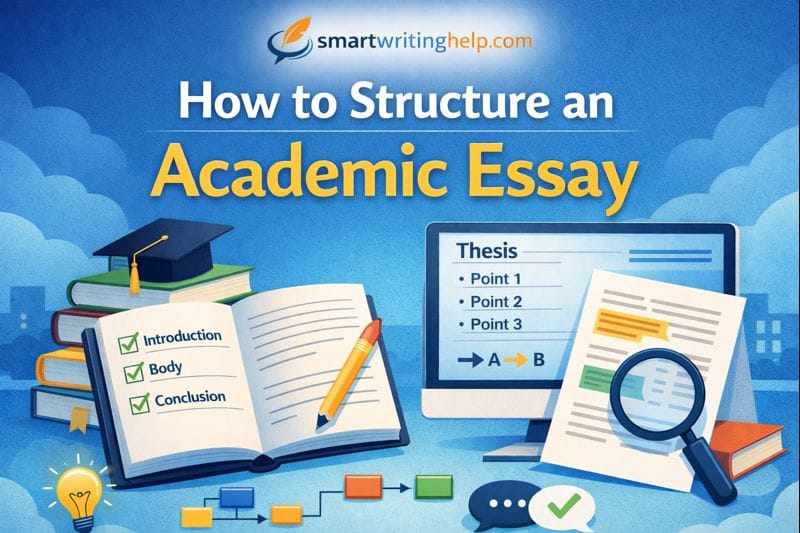
Every academic essay is built on three essential parts. Each part has a specific purpose, and skipping or misusing one weakens the entire paper.
Introduction: Setting the Direction
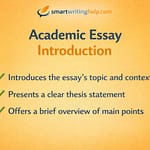
The introduction prepares the reader for what is coming. A strong introduction does three things:
- Introduces the topic in clear terms
- Provides brief background so the reader understands the context
- States the thesis, which is the main argument or position of the essay
Common problem: Students often add too much detail here.
Solution: Keep the introduction focused—save detailed arguments for the body.
Body: Developing Your Argument
The body is where your essay earns its marks. This section explains, supports, and proves your thesis.
An effective body follows these principles:
- Each paragraph focuses on one main idea
- Every paragraph begins with a topic sentence
- Evidence such as examples, data, or quotations is used to support claims
- All points clearly connect back to the thesis
Common problem: Paragraphs feel disconnected or repetitive.
Solution: Ask yourself: How does this paragraph move my argument forward? If it doesn’t, revise or remove it.
Conclusion: Bringing It All Together
The conclusion is not a summary of sentences—it is a summary of meaning.
A strong conclusion:
- Reinforces the main argument
- Shows why the discussion matters
- Leaves the reader with a clear takeaway
Common problem: Introducing new ideas in the conclusion.
Solution: Only work with ideas already discussed—focus on impact, not expansion.
Structure of an Essay
In the body of an essay, ideas should follow a logical order so the argument builds naturally. Start with simpler points, introduce necessary background early, and move toward more detailed or complex analysis. Every paragraph should clearly support the thesis.
Example Table: Good vs Poor Ordering
| Body Paragraph Order | What It Looks Like | Why It Works / Fails |
| Good Order | Paragraph 1: Brief background → Paragraph 2: Main point → Paragraph 3: Deeper analysis | Builds understanding first, then strengthens the argument |
| Poor Order | Paragraph 1: Complex analysis → Paragraph 2: Background → Paragraph 3: Main point | Confuses the reader and breaks logical flow |
How to Organize Information in the Body
Once you know what belongs in the body, the next challenge is deciding what comes first, second, and last.
Start Simple, Then Build Complexity
Effective essays usually move from:
- Simple or widely accepted ideas
- Toward more complex, debatable, or original claims
This approach helps readers follow your thinking without confusion.
Example:
You might begin by explaining a general concept before applying it to a new or controversial situation. The familiar idea gives readers a foundation for understanding your argument.
Place Background Information Early
Readers need context before analysis.
- General background belongs in the introduction
- Additional background should appear at the start of the body, before deeper arguments
Placing background too late forces readers to rethink earlier sections.
Keep Everything Relevant to the Thesis
Every sentence in your essay should serve a purpose.
Ask yourself:
- Does this point support my argument?
- Does it provide necessary explanation?
- Is its relevance clear to the reader?
If the connection is not obvious, revise the sentence or clarify its role.
Parts of an Essay and Their Purpose
| Essay Section | Main Purpose | What to Include |
| Introduction | Prepare the reader | Topic overview, brief background, clear thesis statement |
| Body | Develop the argument | One main idea per paragraph, evidence, analysis linked to the thesis |
| Conclusion | Reinforce meaning | Restated argument, importance of findings, final takeaway |
Common Essay Organization Approaches
Different topics require different structures. Choosing the right approach improves clarity and persuasiveness.
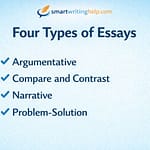
Chronological Structure (Cause and Effect)
This structure explains how something changes over time. Ideas are arranged in the order they happen. It is useful when showing development, progress, or cause-and-effect. The focus is on what came before, what changed, and what followed.
Best used when:
- Writing about historical developments
- Explaining processes or progressions
- Analyzing causes and outcomes
Tip: Even if chronology seems obvious, consider whether another structure might highlight your argument more effectively.
| Essay Section | Purpose | Example (Original) |
| Introduction | Introduce the topic and show why change matters | Growth of online shopping and its impact on consumer habits |
| Body / Paragraph 1 | Explain the situation before the change | Shopping was mostly limited to physical stores |
| Body / Paragraph 2 | Describe the main change | Online platforms made buying faster and more convenient |
| Body / Paragraph 3 | Explain what happened next | Consumer expectations shifted toward speed and home delivery |
| Conclusion | Summarize change and explain importance | Online shopping reshaped modern buying behavior |
Compare-and-Contrast Structure Essay
This structure explains similarities and differences between two subjects. It helps the reader understand strengths, weaknesses, or key distinctions. It is commonly used in analysis and evaluation essays. It works for
- Literature analysis
- Theoretical discussions
- Policy or concept evaluation
- The key is balance—give equal attention to each subject.
| Comparison Point | Option A | Option B |
| Flexibility | Fixed working hours | Flexible schedule |
| Interaction | Face-to-face communication | Online communication |
| Productivity | Structured environment | Self-managed environment |
Problem–Method–Solution Essay Structure
This structure explains one subject fully first, then explains the second subject. Comparisons are made as the second subject is discussed. It works well when readers need a clear understanding of each subject. This structure is ideal for analytical and research-based writing.
It must have:
- Defines a problem
- Explains methods or approaches
- Presents solutions or outcomes
Commonly used in scientific, technical, and social research essays.
| Section | Purpose | Example |
| Body / Paragraph 1–2 | Fully explain Subject A | Office work: structure, teamwork, supervision |
| Body / Paragraph 3–4 | Fully explain Subject B and compare | Remote work: flexibility, independence, challenges |
| Conclusion | Compare overall impact | Both suit different work styles |
Problem–Solution Essay Structure
This structure is used when an essay focuses on fixing an issue. The essay explains the problem, reviews existing approaches, and then presents a solution. It is common in social, technical, and policy-related topics.
| Section | Purpose | Example |
| Introduction | Introduce the problem | Increasing stress among university students |
| Problem | Clearly define the issue | Heavy workload and poor time management |
| Method | Explain current approaches | Counseling services and workshops |
| Solution | Present a better solution | Teaching time-management skills in courses |
| Conclusion | Explain impact | Improved academic performance and wellbeing |
Signposting Method (Describe the Direction of Your Essay)
Signposting uses clear words to guide the reader through the essay. It improves flow and helps readers understand how ideas connect.
| Purpose | Example Phrase |
| Starting a section | “This essay first explains…” |
| Adding a point | “Another important factor is…” |
| Showing contrast | “However, this changes when…” |
| Moving forward | “The next section focuses on…” |
Why Essay Structure Matters More Than You Think
Good structure does more than organize ideas—it:
- Improves clarity
- Strengthens arguments
- Keeps readers engaged
- Helps examiners follow your reasoning easily
A well-structured essay often scores higher even when the language is simple, because the thinking is clear.
Chronological Essay Structure: Turning Events into a Clear Argument
The chronological essay structure organizes ideas according to time, but its real strength lies in showing how one development leads to another. Many students mistakenly treat this structure as a simple timeline. In effective academic writing, chronology is not about listing events—it is about explaining change and impact.
A strong chronological essay helps readers understand why events happened and what they caused, not just when they occurred.
Quick Reference: Chronological Essay Structure
| Section | Purpose | Key Focus |
| Introduction | Set direction | Change-oriented hook, background, cause-effect thesis |
| Body Paragraphs | Develop sequence | One event/period, discussion, consequences |
| Consequences | Provide analysis | Impact, relevance, link to thesis |
| Conclusion | Reinforce meaning | Overall significance and final insight |
Writing a Purpose-Driven Introduction
In a chronological essay, the introduction should prepare the reader for a sequence with meaning, not just a historical overview.
- The hook should signal transformation, conflict, or transition
- The background should describe conditions before the sequence begins
- The thesis should clearly state what the sequence proves
A common weakness in student essays is a thesis that only announces the topic. A stronger thesis explains the direction of change, such as how a development altered society, knowledge, or power structures.
Organizing Body Paragraphs
Each body paragraph should focus on one significant event or period, chosen because it moves the argument forward.
A well-structured paragraph does three things:
- Briefly explains the event or period
- Discusses its role in the broader development
- Shows clear consequences that affect later events
Students often include too many events. This weakens analysis. Fewer, well-explained periods create a clearer and more persuasive essay.
Writing Meaningful Consequences (Where Most Essays Fail)
Consequences are the analytical core of a chronological essay. They explain why an event matters, not just what happened.
Effective consequences:
- Demonstrate cause-and-effect relationships
- Link explicitly back to the thesis
- Prepare the reader for the next stage of development
If a paragraph ends without explaining what changed as a result, the structure becomes descriptive rather than analytical.
Knowing When to Use a Chronological Structure
A chronological structure should be used when your topic involves change over time and the order of events helps explain meaning or impact. It works well for topics that develop in clear stages, where earlier actions influence later outcomes.
This structure is less suitable when an essay depends mainly on abstract ideas rather than progression.
This structure works best when:
- Explaining historical or social change
- Analyzing processes with clear stages
- Tracing developments over time
- Showing long-term impacts of earlier decisions
It is less effective for essays that rely on abstract debate rather than progression.
Essay Overview Sections
An essay overview provides a clear structural summary that helps readers follow your ideas. Placed near the introduction ending, it gives a section outline and an essay roadmap, offering an organization preview.
Without overview, readers may become confused by the flow of information, especially in essays with multiple sections. Including it ensures clarity, guiding readers through each part and keeping your essay cohesive.
When to Use an Overview Paragraph
An overview paragraph is particularly useful in long essays or multi-section essays where ideas are complex. It provides reader guidance, strengthens structural clarity, and previews each section, giving the audience a roadmap.
If an overview is missing, readers may struggle to understand how sections relate to each other, losing the thread of the argument.
Adding an overview in these situations solves this problem, helping readers anticipate key points and follow your reasoning easily.
How to Write a Clear Essay Overview
To write a strong essay overview, start with a brief description of your essay’s purpose in present tense overview.
Show the section order, emphasize the main ideas, and provide a structural explanation. If you do not follow these steps it can make the overview confusing, leaving readers unsure of the essay’s structure. Including concise guidance ensures readers immediately understand the flow, making the essay easier to navigate and more effective.
Transitions Words
Using transition words is essential for linking ideas and maintaining smooth paragraph connections. Without them, readers can lose track of how your points relate to each other, making your essay feel disjointed. Incorporating transitions improves flow and guides the reader seamlessly from one idea to the next, enhancing overall cohesion.
For example, using “Furthermore” at the start of a paragraph can connect it to the previous point about research findings, making the argument feel continuous.
Effective transition sentences show the logical relationships between paragraphs. If these sentences are missing or weak, the essay can feel abrupt, and arguments may seem unconnected.
Example:
This problem leads to the need for a new methodology” clearly signals the connection between problem and solution sections.
Transitions also help manage the pacing of your essay. Using phrases to indicate cause, contrast, or sequence allows your essay to progress naturally. Failing to use these signals can confuse readers or interrupt the flow, but strategically placing them ensures cohesion and a professional, readable structure.
Example:
In contrast to previous studies, our findings suggest that students who engage in collaborative learning retain information more effectively, highlighting the importance of group activities in educational settings.
Types of Transition Words
1. Addition / To Add More Information
Use: To add extra points or build on an idea.
Words/Phrases: and, also, moreover, furthermore, in addition, as well as
Example: “Furthermore, the study shows that students who collaborate retain information better.”
2. Contrast / Opposing Ideas
Use: To show differences or contradictions between ideas.
Words/Phrases: but, however, although, on the other hand, in contrast, nevertheless, yet
Example: “In contrast to previous studies, our research found that independent study can be more effective than group study in certain subjects.”
3. Cause / Effect / Result
Use: To indicate reason, consequence, or result.
Words/Phrases: therefore, thus, as a result, consequently, hence, for this reason
Example: “The experiment lacked sufficient participants; therefore, the results may not be generalizable.”
4. Sequence / Order / Time
Use: To show order, sequence, or steps in a process.
Words/Phrases: first, second, next, then, finally, subsequently, afterwards
Example: “First, we analyzed the survey data; next, we conducted interviews to confirm the findings.”
5. Example / Illustration
Use: To give examples or illustrate a point.
Words/Phrases: for example, for instance, such as, namely, to illustrate
Example: “Many students prefer visual aids in learning, for instance, using charts or diagrams during lectures.”
6. Emphasis / Importance
Use: To highlight key points or show significance.
Words/Phrases: indeed, especially, significantly, in particular, notably
Example: “Significantly, collaborative exercises increased engagement among all participants.”
7. Comparison / Similarity
Use: To show similarity between ideas.
Words/Phrases: similarly, likewise, just as, in the same way
Example: “Similarly, previous research has shown that active learning improves student performance.”
Avoiding Overuse of Transitions
While transition words and transition sentences are essential for linking ideas and improving paragraph connections, overusing them can disrupt the natural flow of your essay. The problem arises when too many transitions make the writing feel forced or repetitive, drawing attention away from your argument.
To prevent this, use transitions strategically only where they clarify logical relationships or improve flow. Avoid inserting them in every sentence or between ideas that are already clearly connected. For example, instead of writing, “Furthermore, additionally, moreover, the study shows…”, choose just one transition: “Furthermore, the study shows…”. This keeps the writing smooth and professional.
Tip : Balancing transitions
It strengthens cohesion. Readers should sense the connections between paragraphs naturally, without being overwhelmed by repeated signals. By using transitions thoughtfully, you maintain clarity while avoiding clutter, ensuring your essay is readable and logically structured.
Common Essay Structure Mistakes
Many students struggle with common essay structure mistakes, which can make even strong arguments hard to follow. Recognizing these errors early helps improve clarity, cohesion, and overall readability.
1- Weak Introductions
A weak introduction often fails to present the topic clearly or provide a strong thesis statement. Without a clear opening, readers may be unsure of the essay’s purpose.
It strengthens introductions by stating the topic, giving background, and clearly presenting your thesis. For example, instead of starting abruptly, write: “This essay examines how collaborative learning improves student engagement and retention, arguing that group activities are essential in modern education.”
2- Poor Paragraph Organization
Poor paragraph organization occurs when paragraphs lack a clear topic sentence or stray from the main point. This can confuse readers and weaken your argument.
Fix it by starting each paragraph with a clear topic sentence and ensuring all sentences relate directly to the main idea. For instance, a paragraph about study methods should not suddenly introduce unrelated research findings.
3- Missing Logical Flow
Missing logical flow happens when ideas are presented out of order or without effective transitions, leaving readers lost.
The solution is to use transition words and sentences to show logical relationships, moving smoothly from one idea to the next. For example: “After examining the benefits of collaborative learning, we now consider its impact on independent study skills.”
Essay Structure Checklist
Using an essay structure checklist helps ensure your essay is well-organized and error-free. It highlights potential gaps in planning, writing, and reviewing, allowing you to fix issues before submission.
- Ensures essay is well-organized and complete
- Highlights gaps in planning, writing, and reviewing
1- Pre-Writing Checklist
A pre-writing checklist ensures your essay starts on the right track. Common gaps at this stage include unclear thesis statements, insufficient research, or missing section outlines.
Solutions include drafting a clear thesis, noting key points for each paragraph, and planning your essay roadmap. For example, before writing, list your main arguments and the order in which you will present them to maintain logical relationships and cohesion.
- Clear thesis statement
- Research and evidence gathered
- Section outline or essay roadmap prepared
- Key points for each paragraph noted
- Logical order of ideas planned
2- Final Review Checklist
The final review checklist helps catch errors in structure, flow, and clarity. Gaps often include weak transitions, off-topic paragraphs, or missing conclusions.
Checklist involves reading each paragraph for logical flow, checking paragraph connections, and verifying that your introduction and conclusion align with the thesis. For example, confirm that each paragraph begins with a topic sentence and that transitions guide the reader smoothly through your points.
| Checklist Item | What Can Go Wrong (Gap) | Solution / How to Fix It | Example |
| Strong Introduction & Conclusion | Introduction doesn’t clearly state the thesis; conclusion doesn’t tie back | Ensure introduction presents topic and thesis; conclusion summarizes main points and reinforces thesis | Intro: “This essay examines how collaborative learning improves retention.” Conclusion: “Thus, group activities are essential for effective learning.” |
| Paragraph Topic Sentences | Paragraphs start abruptly or lack focus | Begin each paragraph with a clear topic sentence that relates to the thesis | “Collaborative study sessions increase engagement and understanding among students.” |
| Effective Transitions | Weak or missing transitions make flow confusing | Use transition words and transition sentences to connect paragraphs | “In contrast to independent study, group learning encourages discussion and peer support.” |
| Logical Flow | Ideas presented out of order, confusing argument | Arrange paragraphs in a sequence that builds your argument logically | Start with benefits of collaborative learning, then challenges, then strategies for implementation. |
| Cohesion | Paragraphs feel isolated; ideas don’t link | Link ideas using references, examples, and repeated keywords | “These strategies not only improve engagement but also reinforce the key skills discussed earlier.” |
Conclusion
A strong essay relies on clear structure, which helps the reader follow your ideas and strengthens your argument. Many essays fail due to weak planning or missing organization.
Focusing on structure ensures clarity, cohesion, and a professional presentation.
Different essay types require different approaches. The flaw occurs when one structure is applied to every type, causing confusion. Adapting the structure to the essay’s purpose maintains logical flow and clarity.
FAQS
What is the structure of an essay?
An essay typically has three parts: an introduction that presents the topic and thesis, a body with organized paragraphs supporting your argument, and a conclusion that summarizes key points and reinforces the thesis.
Why is structure important in an essay?
Structure helps your essay flow logically, making it easier for readers to follow your ideas. A clear structure also ensures your arguments are well-organized and your thesis is supported effectively.
How do I compare and contrast in a structured way?
Use either the alternating method (comparing points side by side) or the block method (covering each subject separately). Ensure each paragraph has a clear topic sentence and maintains logical flow.
Do I have to stick to my essay outline as I write?
Outlines are a guide, not a rule. You can adjust your structure as needed, but ensure all changes maintain logical flow, relevance to your thesis, and clarity for the reader.