ChatGPT has become one of the most talked-about technologies of our time — and for good reason. Since its launch in November 2022, it has attracted over 800 million weekly active users and fundamentally changed how people interact with computers. But despite its widespread use, most people have no idea how it actually works under the hood.
In this guide, we break down everything: what ChatGPT is, the technology that powers it, how it processes your questions, how it was trained, and why it sometimes gets things wrong. Whether you are a complete beginner or a developer looking for a deeper explanation, this article covers it all.
Key Takeaways
-ChatGPT is a generative AI chatbot built on large language models (LLMs) and trained by OpenAI
– Its core operation is simple: predict the next most likely token, one at a time
– It uses a transformer architecture with self-attention to understand relationships between words across a full input sequence
– Training involves three stages: pre-training on internet-scale text, supervised fine-tuning, and reinforcement learning from human feedback (RLHF).
What Is ChatGPT?
ChatGPT is a generative AI chatbot developed by OpenAI. It uses natural language processing (NLP) to hold human-like conversations and generate content including articles, code, summaries, translations, and advice.
The name breaks down like this:
– Chat — it is designed for conversational dialogue
– GPT — stands for Generative Pre-trained Transformer, the type of AI model that powers it
Unlike older AI chatbots that followed rigid scripts, ChatGPT uses a dialog format that allows it to answer follow-up questions, admit uncertainty, and even reject inappropriate requests. It was initially powered by GPT-3.5 and now runs on GPT-4o — a multimodal model that can process text, images, audio, and video.
Who Made ChatGPT?
OpenAI, a San Francisco-based AI company, created ChatGPT and released it publicly on November 30, 2022. OpenAI was co-founded in 2015 by Sam Altman, Elon Musk, Ilya Sutskever, Greg Brockman, and others. Microsoft has invested over $13 billion in the company and powers its infrastructure through Azure cloud computing.
The Core Concept: What ChatGPT Is Actually Doing
Before diving into the technical details, it helps to understand the single fundamental thing ChatGPT does:
ChatGPT predicts the next most likely word — one word at a time.
That is it. Everything you see — the essays, the code, the advice, the conversation — is the result of repeating this one operation thousands of times per response.
Here is a simple example. Given the text:
“The capital of France is…”
ChatGPT scans the statistical patterns it learned from billions of web pages and predicts the next word should be “Paris” — because that is what follows that phrase the vast majority of the time in its training data.
It then uses “Paris” as part of the new context and predicts the next word, then the next, and so on, until the response is complete.
Why Is This So Powerful?
At first glance, predicting the next word sounds trivial. But here is the key insight: to predict the next word well, you need to understand how the world works.
If ChatGPT can complete the sentence “If I put a grape in a sealed box and knock the box over, the grape is now…” it must have some internal model of gravity and physics — learned purely from text.
This is why next-word prediction unlocks so much capability. It forces the model to build a functional representation of reality simply by reading enough human-written language.
Technology Behind ChatGPT
Understanding how ChatGPT works requires understanding four core technical concepts: large language models, neural networks, the transformer architecture, tokens, and embeddings.
Large Language Models (LLMs)
ChatGPT is built on a large language model (LLM) — a type of AI model trained on enormous amounts of text to understand and generate human language.
LLMs consist of billions of parameters (also called weights) — essentially numbers that encode the statistical relationships the model has learned. These are not a database of facts. Instead, they are a compressed representation of patterns across the entire training dataset.
When you ask a question, the model does not “look up” an answer. It uses those weights to calculate the most probable sequence of tokens to respond with.
Neural Networks and Deep Learning
LLMs are built on deep learning neural networks — computational systems loosely inspired by the human brain. A neural network consists of layers of nodes (neurons) that transform input data through a series of mathematical operations.
The “deep” in deep learning refers to the many layers in these networks. GPT-3 has 96 transformer layers. Each layer progressively builds a richer understanding of the input.
The Transformer Architecture
The most important technological breakthrough enabling ChatGPT is the transformer architecture, introduced in the 2017 paper “Attention Is All You Need” by Google researchers.
Before transformers, AI language models processed text sequentially — one word at a time — making it hard to relate words far apart in a sentence. Transformers solved this with a mechanism called self-attention.
Self-attention allows the model to look at every word in the input simultaneously and weigh how relevant each word is to every other word. For example, in the sentence “The trophy didn’t fit in the bag because it was too big,” the model needs to understand that “it” refers to “trophy,” not “bag.” Self-attention makes this possible.
Each transformer layer contains multiple attention heads — GPT-3 has 96 attention heads — each looking for different types of relationships between tokens. The outputs of all heads are combined to form a richer understanding of the text.
Tokens: The Unit of Language
For example:
– “running” → one token
– “unbelievable” → might become “un” + “believ” + “able” → three tokens
– “ChatGPT” → could be split into two or three tokens
Why tokens instead of words? Tokens allow the model to handle rare words, compound words, and words in many languages without needing an impossibly large vocabulary. GPT-3 was trained on roughly 500 billion tokens.
The total number of tokens a model can process at once is called the context window — a key limit that determines how much of a conversation the model can “remember” at once.
Embeddings: Turning Language Into Math
Before the transformer can process tokens, each one must be converted into a mathematical representation the model can work with. This is called an embedding.
An embedding is a list of numbers (a vector) that represents a token’s meaning. The key property is that semantically similar tokens have similar embeddings — meaning their vectors are “close” to each other in mathematical space.
For instance, the embeddings for “dog” and “puppy” are much closer to each other than “dog” and “refrigerator.” This allows the model to understand relationships between concepts without being explicitly programmed with definitions.
ChatGPT also creates embeddings not just for individual tokens, but for entire sequences of text — capturing the meaning of a full sentence or paragraph as a single vector.
How ChatGPT Processes Your Request (Step-by-Step)
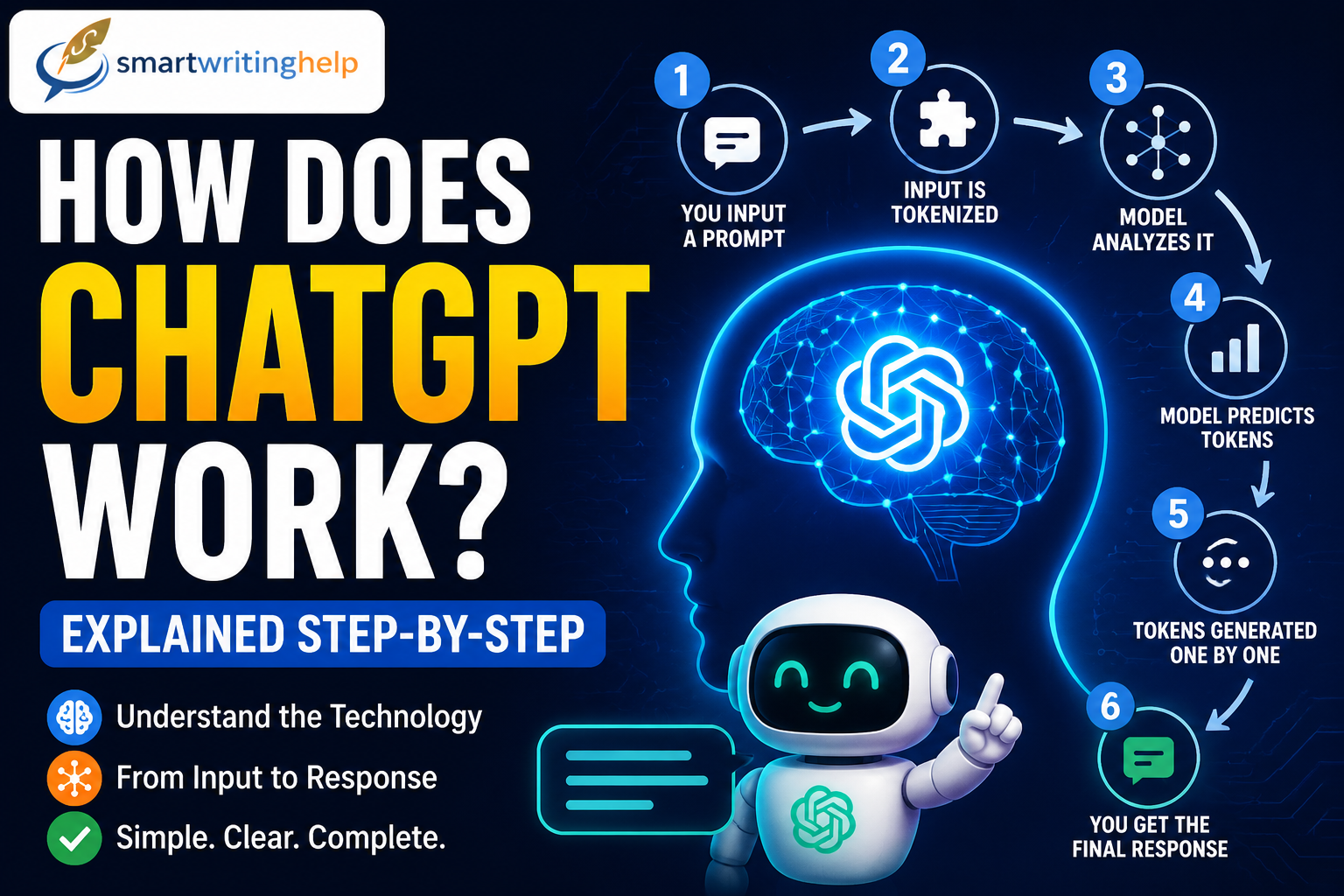
When you send a message to ChatGPT, here is exactly what happens behind the scenes:
Step 1 — Input: Your text is received by the system.
Step 2 — Tokenization: Your text is broken down into tokens. “How does ChatGPT work?” might become [“How”, ” does”, ” Chat”, “GPT”, ” work”, “?”].
Step 3 — Embedding: Each token is converted into a high-dimensional vector (a list of hundreds or thousands of numbers) that encodes its meaning and position in the sequence.
Step 4 — Transformer Processing: The embeddings pass through dozens of transformer layers. At each layer, the self-attention mechanism identifies relationships between tokens, and the model builds an increasingly sophisticated understanding of what you are asking.
Step 5 — Weight Multiplication: The processed embeddings are multiplied against hundreds of billions of learned model weights — a computationally intensive operation that produces a probability distribution over all possible next tokens (roughly 50,000+ possibilities).
Step 6 — Sampling: The model samples from that probability distribution to pick the next token. It does not always pick the single most likely token — a temperature parameter introduces controlled randomness, making responses more natural and varied.
Step 7 — Repeat: The new token is added to the context, and steps 3–6 repeat until the response is complete (signaled by a special stop token).
What Is “Temperature” in ChatGPT?
Temperature controls how “creative” or “random” the outputs are:
– Low temperature (0.0–0.3): Predictable, deterministic, safe responses — always picks the highest-probability token.
– Medium temperature (0.7–0.8): Balanced creativity — used for most chat and essay tasks.
– High temperature (1.0+): More surprising and varied outputs — can be more creative but also more likely to go off-track.
How ChatGPT is Trained
ChatGPT’s training happens in multiple stages, each building on the last.
Stage 1: Pre-Training (Unsupervised Learning)
This is where the model learns the statistical patterns of language by training on a massive corpus of text from the internet, books, Wikipedia, code repositories, and more.
– GPT-3 was trained on over 45 terabytes of text and roughly 500 billion tokens
– The process is called self-supervised learning — the model is given a sentence with the last word hidden and must predict it
– Each correct or incorrect prediction nudges the model’s weights slightly through a process called gradient descent
– This is repeated trillions of times until the model becomes highly accurate at next-token prediction
Gradient descent works like a hiker in fog trying to find the lowest point of a mountain. They cannot see far, so they take small steps in whichever direction slopes downward. Over billions of steps, they find their way to the valley floor.
Stage 2: Supervised Fine-Tuning (SFT)
After pre-training, human trainers create example conversations — writing both the ideal user prompt and the ideal assistant response. The model is then fine-tuned on these examples to behave more like a helpful assistant and less like a raw text predictor.
Stage 3: Reinforcement Learning from Human Feedback (RLHF)
This is the most distinctive part of ChatGPT’s training and what separates it from base GPT models.
Here is how RLHF works:
1. The model generates multiple responses to the same prompt
2. Human trainers rank those responses from best to worst
3. A separate reward model is trained on those rankings to predict which outputs humans prefer
4. ChatGPT is then trained using reinforcement learning to maximize the reward model’s score — generating responses that humans are more likely to rate highly
RLHF is what makes ChatGPT helpful, relatively safe, and conversationally natural. It is also why the thumbs-up/thumbs-down buttons on responses actually matter — your feedback helps improve future versions of the model.
Stage 4: Fine-Tuning for Dialogue
On top of RLHF, ChatGPT was also fine-tuned on conversational datasets (including movie dialogues) to ensure it responds naturally to back-and-forth exchanges, handles follow-up questions, and maintains context across a conversation.
Chain-of-Thought Reasoning (Advanced Models)
Newer models like OpenAI o1 go beyond the standard approach. They are trained to use chain-of-thought (CoT) reasoning — breaking a complex problem into smaller steps, trying multiple approaches, and checking intermediate conclusions before arriving at a final answer.
What Can ChatGPT Do?
ChatGPT’s versatility comes from its broad training data combined with RLHF fine-tuning. Here are its major use cases:
Writing and Content Creation
– Draft emails, articles, blog posts, and social media copy
– Overcome writer’s block with prompts, outlines, and first paragraphs
– Edit and improve existing writing for grammar, clarity, and tone
Research and Information
– Answer questions and explain complex topics in plain language
– Summarize long documents, papers, or reports
– Search the web in real time (with ChatGPT Search enabled)
Coding and Technical Work
– Write working code in dozens of programming languages
– Explain unfamiliar code
– Debug errors and identify edge cases
– Translate code between languages
Business and Productivity
– Conduct market research and draft business plans
– Write job application materials (resumes, cover letters)
– Generate SEO keywords and content outlines
– Translate between 80+ languages
Creative and Personal
– Brainstorm ideas for any project
– Write stories, scripts, poems, and creative content
– Offer advice and act as a sounding board
ChatGPT’s Limitations
Despite its impressive capabilities, ChatGPT has significant limitations that users must understand.
Hallucinations: When ChatGPT Makes Things Up
The most dangerous limitation is hallucination — when ChatGPT confidently states something that is completely false.
This happens because ChatGPT does not have access to a database of verified facts. It only knows what patterns of text it has seen during training. When asked about something it has little or no training data on — such as a very specific person, an obscure event, or a recent development — it will still generate a plausible-sounding response, because that is what it always does.
It cannot distinguish between “I know this” and “I am guessing.” This is a fundamental limitation of the architecture, not a bug to be patched.
Examples of hallucination:
– Fabricating academic citations with real-sounding author names and paper titles
– Making up statistics about companies or people
– Inventing historical events that never happened
Mitigation: Always verify important facts from ChatGPT against authoritative sources.
Reasoning and Logic Failures
Standard LLMs are surprisingly poor at:
– Counting letters (“How many R’s in strawberry?”)
– Comparing decimals (“Is 9.11 greater than 9.5?”)
– Multi-step math and logic puzzles
These fail because the model predicts the most statistically common response — not because it reasons through the steps. Advanced models like o1 significantly improve on this with chain-of-thought reasoning.
Knowledge Cutoff
ChatGPT’s training data has a cutoff date. It knows nothing about events after that date unless it has access to real-time search (a feature that requires ChatGPT Search to be enabled). By default, asking it about recent news will yield outdated or fabricated answers.
Bias
ChatGPT inherits biases from its training data. If the internet over-represents certain perspectives, demographics, or viewpoints, the model’s outputs will reflect that. This can manifest as biased descriptions of people, stereotypes, or skewed analysis of controversial topics.
ChatGPT Models and Versions
OpenAI has released several versions of ChatGPT models over time, with each new generation offering better accuracy, improved reasoning, faster responses, and more advanced capabilities such as multimodal processing and chain-of-thought reasoning.
| Model | Key Features | Available In |
|---|---|---|
| GPT-3.5 | Fast, capable, original ChatGPT model | Free Tier |
| GPT-4 | More accurate, handles longer context | Plus / Team |
| GPT-4o | Multimodal support for text, image, audio, and video | Plus / Pro |
| GPT-4.5 | More human-like interactions and responses | Pro |
| o1 / o3 | Advanced reasoning for complex tasks and problem-solving | Pro |
The model you get depends on your subscription tier. Free users typically access GPT-4o with daily limits, while paid tiers unlock more powerful models with higher usage limits.
Environmental and Ethical Impact
ChatGPT’s capabilities come with real costs — financial, environmental, and social.
Energy Consumption: A single ChatGPT query uses approximately 10 times more electricity than a traditional Google search. As hundreds of millions of users shift toward AI-powered search, global energy demand from AI is growing rapidly.
Carbon Footprint: Training GPT-3 produced an estimated 552 tons of CO₂. Models have grown far more complex since then.
Water Usage: Data centers training and running AI models consume large volumes of water for cooling.
Cost of Advanced Reasoning: OpenAI’s o3 reasoning model can consume over $1,000 of compute per complex task.
Job Displacement Concerns: While some worry ChatGPT will replace knowledge workers, most analysts argue it will serve as a productivity tool that augments human work rather than eliminating it — similar to how the spreadsheet or the internet transformed but did not eliminate office work.
Academic Integrity: The ease with which ChatGPT produces human-like writing has created serious challenges for educators. AI text detectors exist but have accuracy rates ranging from only 60–84%, making detection unreliable.
Frequently Asked Questions
Sources: OpenAI, Zapier, IBM Think, Coursera, TechTarget, Built In, Stephen Wolfram Writings, The Pragmatic Engineer