You get an essay prompt. It says “analyze,” or “discuss,” or “argue,” and you stare at it wondering: what is this professor actually asking me to write?
That one moment of confusion is where most lost grades start — not in the writing itself, but in misreading what type of essay the assignment calls for.
Decoding What Your Essay Prompt Is Asking For
Before you can write the right essay, you need to translate the prompt. Most confusion about academic essay types traces back to instructional verbs — the words in the assignment that signal structure and tone.
| If Your Assignment Says… | You Likely Need… |
|---|---|
| Explain, Describe, Summarize, Define | Expository Essay |
| Argue, Evaluate, Take a Position, Convince | Argumentative Essay |
| Narrate, Reflect, Recount | Narrative Essay |
| Analyze, Interpret, Examine | Analytical Essay |
| Describe in Detail, Create a Picture Of | Descriptive Essay |
If a prompt mixes verbs (for example, “explain and evaluate”), it usually wants a primarily argumentative essay that opens with expository context. When in doubt, check your assignment rubric for grading language like “thesis,” “evidence,” or “objective tone” — these point directly to the expected essay type.
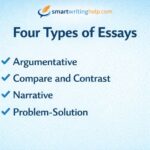
4 Core Academic Essay Types
Every essay type exists to solve a specific communication problem. Here’s what each one is actually for, not just what it’s called.
Argumentative Essay: When You Need to Convince Someone
An argumentative essay solves the problem of persuading a skeptical reader using evidence, not opinion. It requires a clear thesis statement, a stance, and academic sources that support your reasoning rather than personal feeling alone.
Where students get stuck: relying on opinion instead of evidence, or only presenting one side of the argument, which weakens credibility. The fix is addressing a counterargument directly before refuting it — that’s what separates a college-level argumentative essay from a rant.
Typical structure: introduction with thesis → body paragraphs with evidence and counterargument → conclusion that reinforces the stance.
Expository Essay: When You Need to Explain Something Clearly
An expository essay solves the problem of informing a reader without bias. It’s the most common essay type assigned in high school and intro college courses because it tests whether you can organize facts logically.
Where students get stuck: sneaking in personal opinion, which breaks the objective tone the format requires. If you catch yourself writing “I think” or “I believe,” that’s a sign you’ve drifted into persuasive territory.
Narrative Essay: When the Assignment Wants Your Story
A narrative essay solves the problem of conveying a lesson or insight through personal experience. It’s the format behind most college application essays and reflective writing assignments.
Where students get stuck: writing a play-by-play of events with no reflection. A narrative essay needs a “so what” — the moment where you connect the story to a broader insight or change in perspective.
Descriptive Essay: When You Need the Reader to See Something
A descriptive essay solves the problem of recreating a sensory experience on the page — a place, a person, an object, a mood. It leans on sensory language and figurative description rather than argument or analysis.
Where students get stuck: description that floats without focus. A strong descriptive essay still needs a single dominant impression tying every sensory detail together.
Analytical Essay Types
Once you move past intro-level writing, three analytical essay types show up constantly — and forums are full of students mixing them up.
Textual analysis essay: close reading of any text to explain how it produces meaning, not just what it says.
Rhetorical analysis essay: focused specifically on persuasive technique — how a speaker or writer uses ethos, pathos, and logos to move an audience. Common in composition and political science courses.
Literary analysis essay: focused on a literary work specifically — themes, characters, symbolism, and the author’s stylistic choices, backed by textual evidence.
The difference is subject and goal: rhetorical analysis studies persuasion technique, literary analysis studies artistic meaning in fiction or poetry, and textual analysis is the broader umbrella term covering both.
“Wait, Isn’t That the Same as a Persuasive Essay?” — Clearing Up the Mix-Ups
These are the comparisons that generate the most confused questions in student writing communities.
Argumentative vs. persuasive essay: An argumentative essay leans almost entirely on research, data, and logical structure, including a counterargument section. A persuasive essay can lean more heavily on emotional appeal and personal conviction with lighter sourcing requirements. Many instructors now use the terms interchangeably, so always check your specific rubric.
Expository vs. analytical essay: Expository writing explains what something is or how a process works. Analytical writing goes further to explain why it matters or how it produces an effect — it requires interpretation, not just explanation.
Narrative vs. descriptive essay: A narrative essay is built around a sequence of events with a personal arc. A descriptive essay can exist in a single frozen moment with no real plot — its job is atmosphere, not story progression.
Comparing Academic Essay Types
| Essay Type | Core Purpose | Evidence Needed | Personal Voice (“I”) Allowed? |
|---|---|---|---|
| Argumentative | Persuade with evidence-based reasoning | Academic sources, data, counterarguments | Usually no, unless instructed |
| Expository | Explain or inform objectively | Facts, examples, processes | No |
| Narrative | Tell a story with reflection | Personal experience | Yes |
| Descriptive | Recreate a sensory impression | Sensory and figurative detail | Often yes |
| Textual/Rhetorical/Literary Analysis | Interpret meaning or technique in a text | Direct quotations, close reading | Rarely |
“Can I Use ‘I’ in This Essay?” — A Question That Comes Up Constantly
This is one of the most searched and most asked questions in academic writing groups, and the answer depends entirely on essay type. Narrative and descriptive essays are built around personal voice, so first person is expected.
Argumentative, expository, and analytical essays generally avoid “I” because the goal is objective credibility — your evidence should carry the argument, not your personal stance. If your assignment specifically asks for a “personal reflection” attached to an analytical essay, that’s the exception, not the rule.
“How Long Should Each Essay Type Be?”
Length depends on academic level and assignment scope, not essay type alone, but general patterns hold:
-High school essays of any type: roughly 500–800 words
-College argumentative or analytical essays: roughly 1,200–2,500 words, depending on source requirements
-Narrative and descriptive essays for application purposes: often capped at 250–650 words by the institution
-Graduate-level analytical essays: can extend well beyond 3,000 words depending on scope
Always default to the assignment’s word count or page requirement over any general rule — instructors weigh this heavily in grading.
Choosing the Right Essay Type Under Pressure
When a prompt still feels ambiguous, work through this sequence:
- Underline every instructional verb in the prompt (explain, argue, analyze, describe, narrate).
- Check the rubric for words like “thesis,” “objective,” “evidence,” or “reflection” — these confirm the expected tone.
- Identify the subject type. A literary text points toward literary analysis; a speech or ad points toward rhetorical analysis; a personal experience points toward narrative.
- Decide if a stance is required. If yes, you’re writing argumentative. If you’re only explaining, you’re writing expository.
- Draft a one-sentence thesis that matches the essay type before writing a single paragraph — if the sentence sounds like an opinion, you’re in argumentative territory; if it sounds like a fact statement, you’re in expository territory.
Mistakes in Choosing Essay Type
- Argumentative: ignoring counterarguments, which makes the essay look one-sided and under-researched
- Expository: slipping into opinion, which undermines the required objective tone
- Narrative: listing events without reflection, leaving the “so what” missing
- Descriptive: overloading sensory detail without a unifying impression or focus
- Analytical (textual/rhetorical/literary): summarizing the text instead of interpreting it — analysis requires explaining effect, not just content
If You’re Still Stuck on Structure
Even after identifying the right essay type, building a clean structure under a deadline is its own challenge — especially when a rubric is strict about thesis placement, evidence integration, or word count.
Many students cannot write academic essays properly because they consider essays like casual writing, but understanding their formal role provides clarity and direction.
How do I know what type of essay to write?
Look at your essay prompts and focus on keywords like explain, describe, argue, or assess. These instructional verbs guide your essay approach and writing purpose.
What type of essay is most common at university?
Argumentative essays are the most frequent in college essays and university assignments. They require research-based writing, forming an original argument, and following academic standards in a structured essay format.
What are the different types of academic essays?
The main types of academic essays include descriptive, narrative, expository, and argumentative essays. Analytical essays, such as literary, textual, and rhetorical analysis, are also common in academic writing.