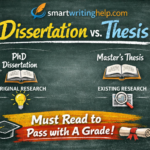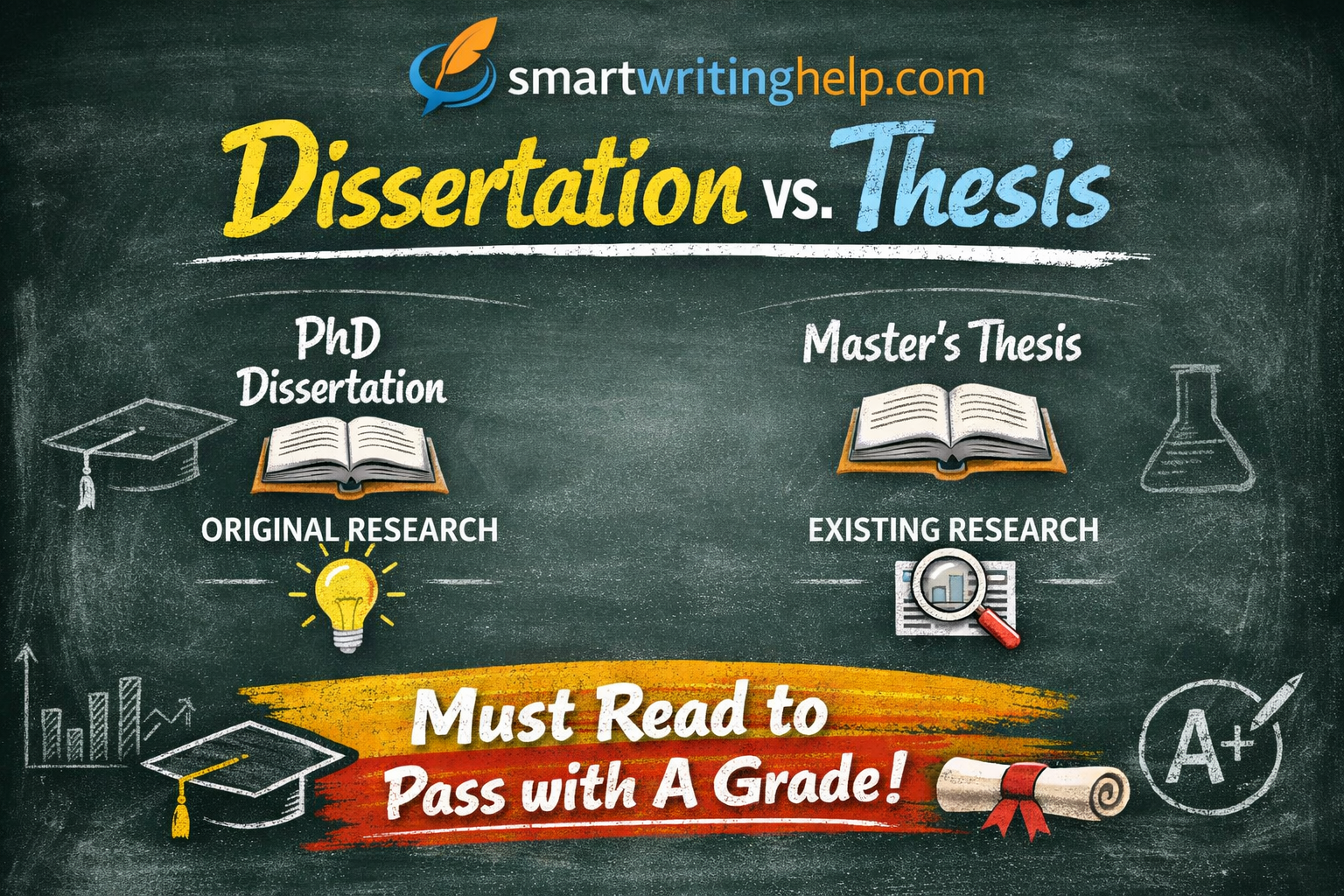
| In the United States, a thesis is a research paper written to complete a master’s degree, while a dissertation is a longer, original research project required for a doctoral (PhD) degree. |
The key differences are: academic level (master’s vs. doctoral), scope (synthesizing existing research vs. contributing new knowledge), and length (40–100 pages vs. 100–300 pages). Note: In the UK and Australia, these terms are often reversed.
Whether you are starting your Master’s degree, planning a PhD, or simply trying to understand the difference between a dissertation and a thesis, you are in the right place. This guide breaks down every key distinction — from word count and structure to examination methods and research expectations — so you can walk into your academic journey fully prepared.
4 Key Takeaways
| 1:Academic Level is the Core Distinction In the US, a thesis is for master’s students and a dissertation is for doctoral (PhD) students. Everything else — length, depth, originality — flows from this single fact. |
| 2: Original Research is the Big Difference: A dissertation must contribute brand-new knowledge to your field. A thesis primarily synthesizes and analyzes existing research. This difference in purpose shapes everything about how each document is written and evaluated. |
| 3: The Terms Are Reversed in the UK and Australia If you are studying abroad or reading international academic literature, be aware: in the UK and Australia, ‘thesis’ refers to the doctoral document and ‘dissertation’ to the master’s one — the exact opposite of US usage. |
| 4: Both Are Gatekeeper Documents for Graduation Despite their differences, both a thesis and a dissertation serve as the final, defining academic project of their respective degree programs. Completing either one is a significant intellectual and professional achievement. |
What Is a Thesis?
A thesis is a substantial academic paper completed at the end of a master’s degree program. The word comes from the ancient Greek ‘tithenai,’ meaning ‘to place’ or ‘to put forward’ — reflecting the idea of a student positioning and defending an argument.
In practice, a thesis demonstrates that you have mastered the knowledge and methods of your field. It typically involves:
- A focused review of existing academic literature on your topic
- An original analysis, synthesis, or interpretation of that literature
- A clearly articulated academic argument or hypothesis
- Data analysis (especially in STEM fields) or theoretical analysis (in humanities)
- A formal conclusion that ties your findings to broader scholarly conversations
A master’s thesis is generally 40 to 100 pages (or 20,000 to 40,000 words) in length. In most programs, you will present your work to a faculty committee in a defense lasting one to two hours.
Does a Thesis Require Original Research?
This is one of the most misunderstood aspects of thesis writing. The short answer: not always, but sometimes. In humanities and social science programs, a thesis may involve entirely secondary analysis — meaning you interpret and argue based on the work of others. In STEM programs, however, a thesis almost always involves original data collection or experimentation. The key distinction is that a thesis is primarily about proving your competence, not necessarily advancing the entire field.
What Is a Dissertation?
A dissertation is a book-length, original research project produced to earn a doctoral (PhD) degree. The word derives from the Latin ‘dissertare’ — meaning ‘to continue to discuss and examine.’ That etymology is fitting: a dissertation is the culmination of years of deep, sustained academic inquiry.
Unlike a thesis, a dissertation must make a genuine, original contribution to human knowledge. It cannot simply review or reinterpret what already exists — it must say something new. This could mean:
- Discovering new data through empirical research
- Developing a new theoretical framework or model
- Applying existing theories in an innovative way to a new domain
- Filling a recognized gap in the academic literature
- Challenging or refining a widely accepted belief within your field
A PhD dissertation typically runs 100 to 300 pages (60,000 to 100,000+ words) and involves a rigorous oral defense — known in the UK as a ‘viva voce’ — lasting two to three hours or more. External reviewers with deep expertise in your topic often participate in the evaluation.
How Long Does a Dissertation Take?
Writing a dissertation is a multi-year endeavor. From the time a doctoral student begins their program to the completion and defense of their dissertation, the process typically takes three to seven years, depending on the field, the research design, and the institution. This timeline includes coursework, qualifying exams, proposal approval, data collection, writing, and revisions.
Dissertation vs. Thesis: Full Comparison Table
| Factor | Thesis | Dissertation |
| Degree Level | Master’s degree | Doctoral (PhD) degree |
| Purpose | Demonstrate mastery of existing knowledge | Contribute original new knowledge |
| Research Type | Synthesizes existing research | Original research & new findings |
| Typical Length (US) | 40–100 pages / 20,000–40,000 words | 100–300 pages / 60,000–100,000+ words |
| Time to Complete | 1–2 years | 3–7 years |
| Defense Duration | 1–2 hours | 2–3+ hours (rigorous viva) |
| Committee | Faculty panel (usually smaller) | Doctoral committee incl. external reviewers |
| Originality Required | Not always required | Mandatory — must advance the field |
| Revision Process | Moderate | Extensive, high stakes |
| UK/Australia Term | Dissertation (UG/Master’s) | Thesis (PhD) |
| US Term | Thesis (Master’s) | Dissertation (PhD) |
Regional Differences: US, UK, Australia & Beyond
One major gap in most articles covering this topic is a thorough treatment of how these terms differ by country. Here is what you actually need to know:
United States
The US follows a clear convention: thesis for master’s, dissertation for doctoral. This is the dominant framework used throughout North American universities.
United Kingdom
In the UK, the terms are essentially flipped. A ‘dissertation’ is typically associated with undergraduate and master’s-level work, while a ‘thesis’ is the document submitted for a PhD or other research doctorate (such as an EngD or MPhil). Institutions like University College London and the University of Nottingham reflect this usage.
Australia and New Zealand
Australian and New Zealand universities generally use ‘thesis’ for any substantial research project at a higher degree level, including PhDs. The term ‘dissertation’ may appear at master’s level at some institutions, but ‘thesis’ is far more common across the board.
Continental Europe
Usage varies widely across European countries and institutions. In Germany, for example, the doctoral document is called a ‘Dissertation,’ while the master’s-level document may be called a ‘Masterarbeit’ (Master’s Thesis). Always follow the terminology used by your specific institution and department.
Latin America and India
In many Latin American academic systems and in India, the term ‘thesis’ is used broadly to refer to research documents at both master’s and doctoral levels. Context — including the degree being pursued — is what signals the document’s scope and depth.
Structure: How a Thesis and Dissertation Are Organized
Both documents share a common skeleton, but a dissertation fills each section with far greater depth and complexity.
Common Sections in Both
- Abstract — a concise summary of the research question, methodology, and key findings
- Introduction — context, research question, objectives, and significance of the study
- Literature Review — survey and critical evaluation of existing scholarship
- Methodology — research design, data collection methods, and analytical framework
- Results / Findings — what the research produced
- Discussion — interpretation of results in light of existing literature
- Conclusion — summary, implications, limitations, and directions for future research
- References / Bibliography — full citation list
Dissertation-Specific Additions
- Research Proposal & Grant Proposal (often formal components of the doctoral process)
- Comprehensive Literature Review chapters (often standalone, book-chapter length)
- Multiple empirical chapters or study phases
- Theoretical Framework chapter (original model or conceptual contribution)
- Appendices with raw data, IRB approvals, instruments, and full statistical output
Career Implications: Does It Matter Which One You Write?
Most competitors completely skip this section — but it matters enormously for students making decisions about graduate education.
When a Master’s Thesis Is Enough
In many professional fields — business, education, social work, clinical psychology, engineering, and public health — a master’s degree with a thesis is the terminal credential for career advancement. Writing a strong thesis demonstrates analytical rigor, independent thinking, and communication skills that employers in both the private and public sectors value highly.
When You Need a Dissertation
If your career goal involves becoming a university professor, a principal research scientist, a senior policy researcher, or a field-defining practitioner in academia, a PhD dissertation is non-negotiable. Doctoral degrees unlock tenure-track academic positions, senior research roles at think tanks and government agencies, and leadership positions in R&D-intensive industries.
Salary and Earning Potential
According to the US Bureau of Labor Statistics, doctoral degree holders earn a median weekly wage significantly higher than those with only a master’s degree, particularly in STEM, economics, and healthcare fields. However, the additional three to five years required for a PhD also delays career entry and income — a genuine trade-off worth considering carefully.
Tips for Writing a Thesis
- Start with a narrow, well-defined research question — broad questions lead to unfocused theses
- Conduct a systematic literature review before forming your argument
- Meet with your faculty advisor or committee chair early and often
- Write your methodology section before you collect data — this clarifies your design
- Use citation management software (Zotero, Mendeley, or EndNote) from day one
- Budget three to six months for writing, and another one to two months for revisions
- Attend thesis defenses in your department before your own — observe what works
Tips for Writing a Dissertation
- Develop a research proposal that your committee approves before beginning full research
- Identify your theoretical framework early — it shapes everything else
- Treat each chapter as a semi-independent paper that could stand alone
- Keep a detailed research journal and methodology log from the first day
- Plan for IRB approval, participant recruitment, and data collection delays
- Schedule monthly check-ins with your dissertation chair, not just when you hit blocks
- Consider writing your literature review in phases as you read, not all at once
- Protect your mental health — doctoral programs have high rates of burnout and imposter syndrome
Common Misconceptions Cleared Up
Myth 1: A thesis and dissertation are just different names for the same thing.
Fact: In the US, they are distinct documents at different academic levels with fundamentally different purposes. While both involve substantial research and writing, the expectations for originality, length, and depth differ significantly.
Myth 2: A dissertation is just a very long thesis.
Fact: Length is just one dimension of the difference. The core distinction is that a dissertation must produce new knowledge — something that has never existed in the academic literature before. That is a qualitatively different task from what a thesis requires.
Myth 3: Everyone who earns a PhD writes a dissertation.
Fact: Some doctoral programs — particularly professional doctorates like the EdD, DBA, or DNP — may require a capstone project or applied dissertation rather than a traditional research dissertation. Always verify the requirements of your specific program.
Bonus: The Golden Thread Checklist for Your Dissertation or Thesis
The ‘Golden Thread’ is the unbroken logical line that runs from your research question through your literature review, methodology, findings and conclusion. Use this checklist to test yours:
- My research question is specific, focused and answerable within my time frame
- My literature review directly connects to my research question — not just broadly to my topic
- My methodology is justified — I explain WHY I chose this approach, not just what it is
- My findings chapter answers my research question directly
- My discussion links findings back to the literature I reviewed
- My conclusion states clearly what I found, what it means, and what future research should explore
- Every chapter connects to the one before and after it — a reader could trace the logic from start to finish
If you do not meet every point of checklist, contact SmartWritingHelp.com — our academic writing experts will help you find the gap and fix it before submission.
Conclusion
The dissertation vs. thesis debate really comes down to three things: where you are in your academic career, what your field expects, and what country you are studying in.
In the United States, a thesis concludes a master’s degree and demonstrates mastery of existing knowledge, while a dissertation concludes a doctoral program and demands an original contribution to your field.
Need Help With Your Dissertation or Thesis? Here Is What SmartWritingHelp.com Offers
Whether you are at Master’s or PhD level, our team of subject-specialist academic writers provides:
- Full dissertation and thesis writing — structured chapter by chapter
- Literature review writing and critical source evaluation
- Methodology chapter support — qualitative, quantitative and mixed methods
- Proofreading, editing and academic language correction
- Viva preparation coaching and mock examination support
- AI to human writing — make AI-generated drafts pass detection tools
All work is 100% human written, delivered on time and accompanied by a free plagiarism report. Startin
FAQs
Which is more difficult, a thesis or a dissertation?
A PhD thesis is more difficult because it requires original research, while a Master’s dissertation focuses on analysing existing work. PhDs also take longer and involve external evaluation.
What is the 3 paper rule?
The 3 paper rule (thesis by publication) allows PhD students to submit three publishable research papers instead of one long thesis, combined with an introduction and conclusion.
What is the difference between a Master’s thesis and a PhD thesis?
A Master’s thesis analyses existing knowledge, while a PhD thesis creates original research. PhDs are longer, more complex, and require independent research.
Is 80% on a dissertation good?
Yes, 80% is an excellent grade and falls in the top First Class category, achieved by a small percentage of students.