A clear structure turns your ideas into a logical, easy-to-follow essay. At 1000 words (about 3–4 pages), proper organization keeps your writing focused, avoids repetition, and helps readers understand your argument.
- Logical Flow: Introduction, body, and conclusion guide ideas naturally.
- Focused Content: Every paragraph supports the thesis without fluff.
- Reader-Friendly: Topic sentences and smooth transitions make complex points clear.
- Strong Arguments: 4–6 paragraphs let you develop ideas fully with evidence.
- Academic Standards: Shows professionalism and careful planning.
Without a good structure, your essay can become confusing, repetitive, or hard to follow.
This guide teaches you how to divide your word count effectively, master APA formatting, and plan your essay paragraph by paragraph. You’ll also learn expert shortcuts and cheat tips to refine your writing, organize your ideas logically, and make your essay clear and polished from start to finish.
Understanding the 1,000-Word Essay Framework
A 1,000-word essay is long enough to develop a clear argument but short enough that structure becomes essential. At this length, every paragraph must serve a purpose. You do not have space to repeat ideas, wander off-topic, or include unnecessary background.
The limit forces you to think critically about what truly supports your thesis and what can be removed. When structured properly, a 1,000-word paper feels complete, balanced, and focused rather than rushed or stretched.
The 10-80-10 Gold Standard Rule
A practical way to structure a 1,000-word essay is the 10-80-10 rule. Around 10 percent of your words should go to the introduction, 80 percent to the body paragraphs, and the final 10 percent to the conclusion.
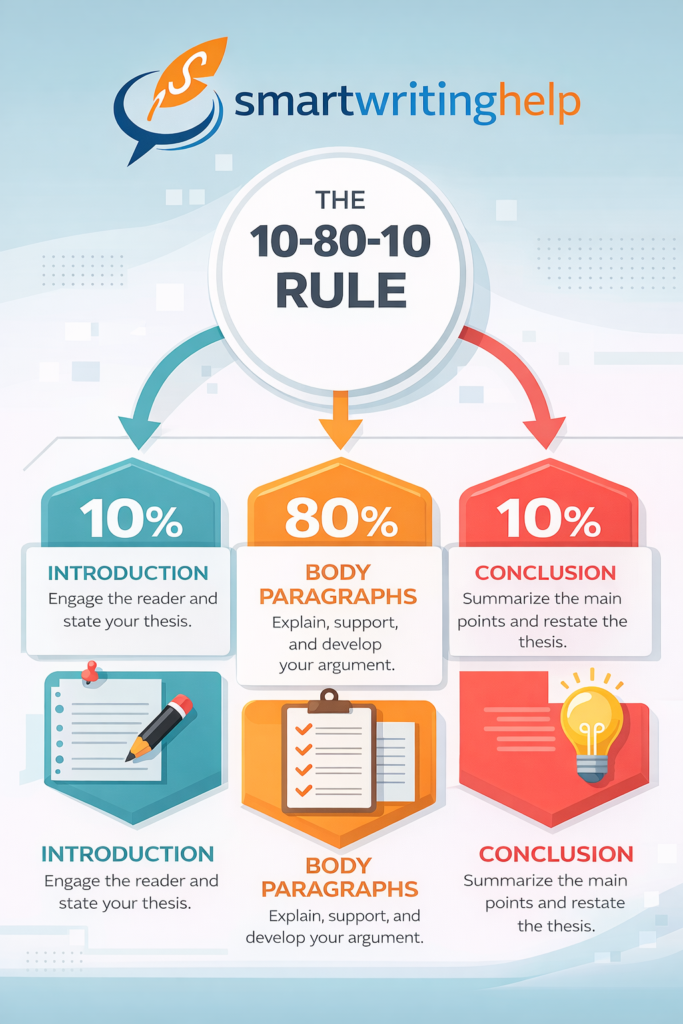
This means roughly 100 words for the introduction, 800 words for the body, and 100 words for the conclusion. This balance ensures your argument is fully developed while keeping the beginning and ending focused and purposeful.
Quality vs. Quantity: Avoiding “Word Count Fluff”
Many students try to reach 1,000 words by adding repetition, long quotes, or unnecessary explanations. This weakens the essay. Quality writing focuses on analysis rather than padding. Instead of repeating a point in different words, deepen it with stronger examples, clearer reasoning, or relevant research.
A well-written 950-word essay with strong structure and precise arguments is always better than a 1,050-word essay filled with fluff. The goal is clarity, not just hitting a number.
Following APA 7th edition, use 1-inch margins, double-spacing, a standard font like Times New Roman or Calibri, and properly formatted headings and quotes. Paragraphs should focus on one main idea using the PEEL method (Point, Evidence, Evaluation, Link) and include smooth transitions.
To save time and improve clarity, write in active voice, cut filler words, reverse outline to check structure, and read aloud to catch awkward sentences.
| Focus Area | Key Points | Quick Tips |
| Word Count | Intro 10%, Body 80%, Conclusion 10%; 4–6 paragraphs | Add evidence if under, cut fluff if over |
| APA Compliance | 1-inch margins, double-space, standard fonts, headings, block quotes | Center title page, follow 5 heading levels |
| Paragraph Planning | PEEL method, one idea per paragraph, smooth transitions | Outline before writing to prevent rambling |
| Efficiency | Active voice, reverse outline, read aloud, cut filler words | Replace noun-heavy phrases with verbs, track word count |
Standard APA 7th Edition Formatting Requirements
Correct formatting in APA 7th edition is not just a technical detail. It directly affects your grades because instructors expect academic papers to follow professional standards. A properly formatted essay shows that you understand academic writing conventions and respect scholarly guidelines. Even a strong argument can lose marks if the formatting is careless or inconsistent.
The Visual Setup: Margins, Fonts, and Spacing
In APA 7th edition, your paper should have 1-inch margins on all sides. The entire document must be double-spaced, including the title page and reference page. You should use a readable, standard font such as 12-point Times New Roman, 11-point Calibri, or 11-point Arial.
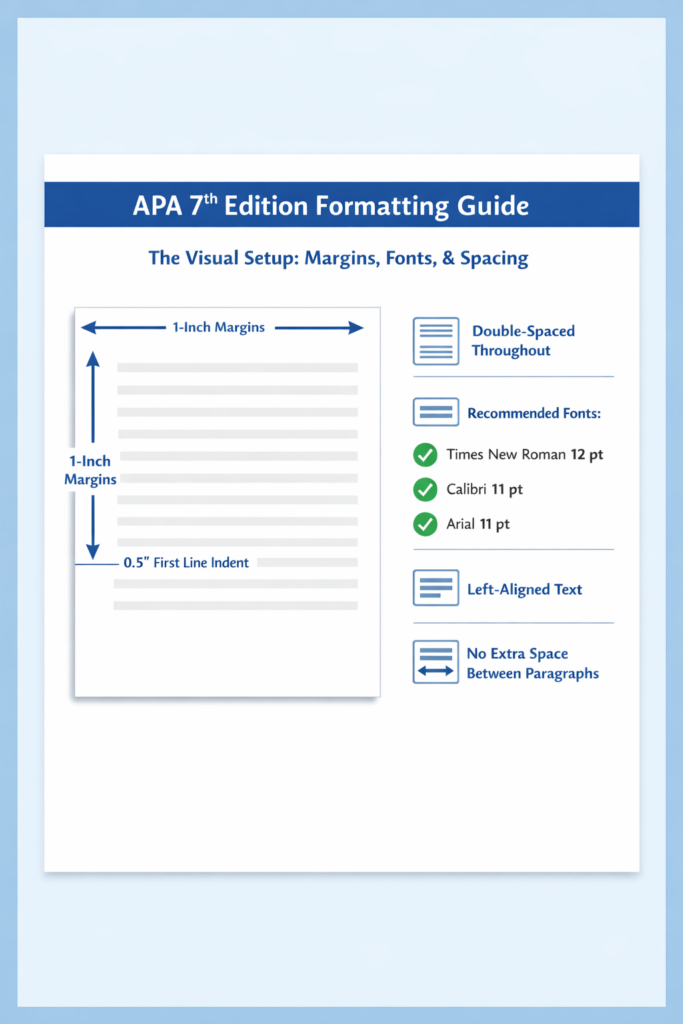
The text should be left-aligned, not justified, and the first line of every paragraph must be indented by 0.5 inches. There should be no extra space between paragraphs. This clean and consistent layout makes your essay easy to read and professionally presented.
Crafting a Professional APA Title Page
A student APA title page includes the title of the paper in bold and centered in the upper half of the page. Below the title, you list your name, institutional affiliation, course name and number, instructor’s name, and the due date. Everything should be double-spaced. The title should be clear and specific, not overly long or vague. A strong title signals the focus of your essay before the reader even begins.
Running Heads and Page Numbers in APA 7th Edition
In APA 7th edition, student papers do not require a running head unless your instructor asks for one. However, page numbers are required. The page number should appear in the top right corner of every page, starting from the title page. This small detail is often overlooked, but it is part of standard academic formatting.
In-Text Citations: Parenthetical vs. Narrative Styles
APA uses the author-date citation system. In parenthetical citations, both the author’s last name and the year appear in parentheses at the end of a sentence, such as (Smith, 2022). In narrative citations, the author’s name appears as part of the sentence, followed by the year in parentheses, such as Smith (2022) argues that clear structure improves academic writing. Both styles are correct, and you can use them strategically to maintain flow and avoid repetition.
The Paragraph-by-Paragraph Breakdown (1,000-Word Blueprint)
A 1,000-word essay works best when every paragraph has a clear job. Instead of writing randomly and hoping it fits the word count, you should follow a structured blueprint. This keeps your argument balanced, logical, and easy to follow.
The Introduction: Hook, Bridge, and Thesis (100–120 Words)
Your introduction should be focused and direct. Start with a short hook that introduces the topic in an engaging but academic way. Then provide a brief background or context to narrow the discussion. End with a clear thesis statement that outlines your main argument. In a 1,000-word essay, the introduction should stay around 100 to 120 words. If it becomes too long, you reduce space for analysis in the body.
Body Paragraph 1: The Primary Argument (Around 150 Words)
The first body paragraph introduces your strongest or most important argument. Begin with a clear topic sentence that connects directly to your thesis. Then add evidence, such as research findings, examples, or data. Follow this with explanation and analysis that shows why the evidence matters. This paragraph sets the tone for the rest of the essay.
Body Paragraph 2: Expanding the Evidence (Around 150 Words)
The second body paragraph builds on the discussion. You may introduce another supporting point or add deeper evidence to strengthen your position. Make sure the paragraph connects logically to the previous one. The goal is not repetition but expansion and development.
Body Paragraph 3: The Deep Analysis (Around 150 Words)
This paragraph moves beyond simple explanation and focuses on deeper interpretation. You can examine implications, compare perspectives, or analyze causes and effects. Strong academic writing goes beyond stating facts and explains their significance.
Body Paragraph 4: Addressing the Counter-Argument (Around 150 Words)
A strong essay acknowledges opposing views. In this paragraph, briefly present a counter-argument related to your thesis. Explain it fairly and accurately. This shows critical thinking and academic maturity.
Body Paragraph 5: Rebuttal and Synthesis (Around 150 Words)
After presenting the counter-argument, respond to it. Explain why your main argument remains stronger or more convincing. You can synthesize evidence from earlier paragraphs to reinforce your position. This strengthens the overall coherence of your essay.
The Conclusion: Restatement Whole Essay and Final Impact (100 Words)
The conclusion should not simply repeat the introduction. Instead, restate your thesis in a fresh way and summarize the key insights from your body paragraphs. End with a final thought that answers the “so what?” question. This leaves the reader with a clear understanding of why your argument matters.
1,000-Word Essay Structure Overview Table
| Section | Paragraphs | Word Count (Approx.) | Purpose |
| Introduction | 1 | 100–120 words | Hook, brief context, clear thesis statement |
| Body Paragraph 1 | 1 | 140–160 words | First main argument + evidence + analysis |
| Body Paragraph 2 | 1 | 140–160 words | Expand argument with supporting research |
| Body Paragraph 3 | 1 | 140–160 words | Deep analysis or detailed explanation |
| Body Paragraph 4 | 1 | 140–160 words | Counter-argument or alternative perspective |
| Body Paragraph 5 | 1 | 140–160 words | Rebuttal and synthesis of ideas |
| Conclusion | 1 | 100–120 words | Restate thesis + final insight (“So What?” factor) |
The MEAL Plan: A Formula for Perfect Academic Paragraphs
The MEAL plan is a simple structure that helps you write strong academic paragraphs. It ensures that each paragraph is focused, supported by evidence, and clearly connected to your main argument. When writing a 1,000-word essay, using the MEAL structure prevents rambling and keeps your ideas organized.
M – Main Idea (Topic Sentence)
Every paragraph should begin with a clear main idea. This is your topic sentence. It tells the reader exactly what the paragraph will discuss and connects directly to your thesis statement. A strong topic sentence is specific, not vague. It guides the direction of the entire paragraph.
E – Evidence (Citations and Data)
After stating the main idea, support it with evidence. This can include research findings, statistics, expert opinions, or examples. In academic writing, evidence often requires APA in-text citations using the author-date format. Evidence strengthens your credibility and shows that your argument is supported by reliable sources.
A – Analysis (Your Original Interpretation)
Evidence alone is not enough. You must explain what the evidence means and how it supports your argument. This is the analysis section. Here, you interpret the information in your own words and connect it back to your thesis. Strong analysis demonstrates critical thinking and separates average essays from high-quality academic work.
L – Link (Transition to the Next Point)
The final part of the paragraph is the link. This sentence connects your discussion back to the main argument or smoothly transitions to the next paragraph. It ensures logical flow and prevents your essay from feeling disconnected. A good link prepares the reader for what comes next.
Example of the MEAL Plan in Table Form
| MEAL Element | What It Does | Example (Online Learning Topic) |
| M – Main Idea | States the focus of the paragraph and connects to the thesis. | Online learning increases flexibility for students, making higher education more accessible. |
| E – Evidence | Provides research, data, or examples to support the claim. | Studies show that students in online programs balance work and family responsibilities more effectively than those in traditional settings (Smith, 2022). |
| A – Analysis | Explains what the evidence means and why it matters. | This shows that flexibility helps more students continue and complete their studies, strengthening access to education. |
| L – Link | Connects back to the thesis or transitions to the next idea. | Therefore, flexibility is a key reason online learning expands educational opportunities. |
Managing Your Word Count Like a Pro
Managing a 1,000-word essay is about balance. You need enough depth to fully develop your ideas, but you must also stay within the required limit. Planning your word distribution in advance helps you avoid rushing the conclusion or overloading one section.
If you are under the word count, do not add filler sentences. Instead, deepen your analysis. Expand your explanation of evidence, add a short example, or clarify how your argument connects to the thesis. Strong academic writing grows through insight, not repetition.
Struggling with word count length
If your essay is too long, focus on cutting unnecessary words. Remove repeated ideas, weak phrases like “in order to” or “basically,” and overly long quotations. Replace wordy expressions with precise verbs. For example, change “conducted an investigation of” to “investigated.” This keeps your writing clear and professional.
Many students also ask whether the reference page counts toward the total word count. In most academic settings, the reference list does not count, but you should always confirm your instructor’s guidelines. Managing your word count carefully ensures your essay remains structured, concise, and aligned with academic standards.
Quick APA Essay Cheat Sheet & Checklist
- Margins & Spacing: 1-inch margins on all sides; double-space the entire paper.
- Font & Alignment: Use 12-pt Times New Roman, 11-pt Calibri, or 11-pt Arial; left-align text with a ragged right edge.
- Paragraphs: Indent the first line 0.5 inches; no extra space between paragraphs.
- Title Page: Center the bolded title; include your name, institution, course, instructor, and date.
- Page Numbers: Top right corner on every page; running head not required for student papers unless instructed.
- In-Text Citations: Use APA author-date style; ensure every citation matches a reference list entry.
- References: Follow APA formatting for capitalization, italics, and punctuation; include all sources cited in the text.
- Block Quotes: Use for quotes over 40 words; indent 0.5 inches and remove quotation marks.
- Proofreading: Read aloud to catch awkward sentences, repetition, or unclear phrasing.
- Paragraph Structure & Flow: Check each paragraph follows MEAL, has smooth transitions, and supports the thesis.
- Final Check: Use grammar and citation tools, but manually verify formatting and accuracy.