Writing a dissertation is a six-stage process: Topic Selection, Proposal, Literature Review, Methodology, Results, and Synthesis. Success depends on maintaining a “Golden Thread” of logic and, in 2026, providing a formal AI Audit Trail to verify the originality of your work.
Key Takeaways
- A dissertation is an independent research project that contributes original knowledge to your field.
- It follows a structured progression: Introduction → Literature Review → Methodology → Results → Discussion → Conclusion.
- Success depends on a focused research question, a clear logical “Golden Thread,” and transparent documentation of your research process (including AI use).
What Is a Dissertation?
A dissertation is an extended, independent research project you submit to complete an academic degree. You drive the entire intellectual process — you identify the problem, design the investigation, collect the evidence, and argue the conclusions.
Universities require it because they want to see you think like a researcher. You identify a gap in existing knowledge, build a rigorous approach to investigating it, and produce findings that contribute to your field.
Dissertation vs. Thesis: What Is the Difference?
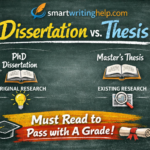
In the United Kingdom, a dissertation is the research project you complete at undergraduate or master’s level. A thesis refers specifically to the doctoral document you submit for a PhD.
In the United States, the terminology flips. A thesis is the master’s-level document and a dissertation is the doctoral one.
For this guide, dissertation refers to any substantial independent research project across all degree levels, because the writing process and chapter structure are fundamentally the same.
Empirical vs. Non-Empirical Dissertations
An empirical dissertation involves collecting original data. You design a study, recruit participants, and analyze what you find through interviews, surveys, experiments, or observations. Psychology, social sciences, business, nursing, and education dissertations typically follow this path.
A non-empirical dissertation builds its argument entirely from existing published material. You critically analyze and synthesize secondary sources rather than generating new data. Law, philosophy, history, and literature dissertations most often fall here.
How to Choose a Dissertation Topic
Most students spend too long here. They wait for a perfect idea to arrive fully formed. It never does.
Your goal is not to find a perfect topic. Your goal is to find a workable topic — one you can investigate thoroughly with the time, access, and skills you have right now.
Start With What Genuinely Interests You
You will spend hundreds of hours with this topic. Choosing something you are indifferent to is one of the most damaging mistakes a dissertation student makes.
Go back through your course materials. Which lectures made you sit forward? Which readings sparked questions you kept thinking about? Your dissertation topic lives somewhere inside those answers.
Read the Literature to Find the Gap
Once you have a broad area of interest, read existing research with one specific purpose: find what is missing.
Pay close attention to the final sections of published papers. Phrases like “further research is needed,” “this study was limited to,” and “future studies should examine” are explicit invitations pointing you toward viable research gaps.
Identifying that gap is the intellectual foundation your entire dissertation stands on.
Turn a Broad Interest Into a Focused Research Question
A broad interest is a starting point, not a research question. A research question is specific, bounded, and answerable within your timeframe.
| Example Weak: What is the relationship between social media and mental health? Strong: How does passive Instagram use affect self-reported self-esteem among female undergraduate students aged 18–22 at UK universities? |
That specificity makes it researchable. It also makes it original.
Check Feasibility Before You Commit
A brilliant topic you cannot execute is worse than a modest topic you can. Before you commit, confirm you have access to participants or data, the skills to conduct the research, a supervisor with relevant expertise, and enough time.
| Pro Tip Do not wait until your topic is perfect before you move to the proposal stage. A focused, workable topic that gets approved is worth more than a brilliant idea that stays in your head for three months. |
How to Write a Dissertation Proposal
Most universities require you to submit a dissertation proposal before you begin the full project. Think of it as a research plan that earns you permission to proceed.
A strong proposal does three things. It demonstrates a genuine research gap exists. It shows your methodology is appropriate for your research question. And it proves your project is achievable within the time frame.
What to Include in Your Dissertation Proposal
Working title — Specific and descriptive. It will probably change, but it should communicate your focus from day one.
Background and rationale — Explain why this topic matters and what specific gap you are addressing.
Research questions and objectives — State your central research question clearly. Then list three to five specific, measurable objectives that map out how you will answer it.
Preliminary literature review — A concise overview of key studies and theoretical frameworks in your area. Show you understand the existing debate.
Proposed methodology — Name your research philosophy, approach, design, and data collection methods. Justify every choice.
Timeline — Present a realistic schedule as a Gantt chart. Build in time for ethics approval, data collection delays, and revisions.
Reference list — All sources cited in your proposal, formatted in your institution’s required referencing style.
The Two Mistakes That Get Proposals Rejected
The most common rejection is a mismatch between the research question and the proposed methodology. If your question asks how or why something happens, a quantitative survey alone is probably insufficient. If it asks to what extent or how many, you need quantitative data, not interviews.
The second most common mistake is a scope that no one person could realistically execute. Narrow the scope until it becomes genuinely achievable within your timeframe.
Understanding Dissertation Structure
Before you write a single word, understand the architecture of a dissertation and why each chapter exists. The structure mirrors the logical progression of a research project from start to finish.
Think of it as a chain: each chapter builds on the last, and together they form one continuous argument.
Dissertation Structure — The Logic Chain
Each chapter builds on the last. Together they form one continuous argument.
| 01 | Introduction | → | Introduce the problem |
| 02 | Literature Review | → | Show what is known |
| 03 | Methodology | → | Explain how you investigated |
| 04 | Results | → | Report what you found |
| 05 | Discussion | → | Interpret what it means |
| 06 | Conclusion | → | Declare what you contributed |
| Chapter | Core Purpose | Typical Length |
| Abstract (not included in chapters) | Summary of the entire dissertation | 150–350 words |
| 1- Introduction | Background, aim, objectives, scope | 1,500–3,000 words |
| 2- Literature Review | Critical synthesis of existing research | 3,000–8,000 words |
| 3- Methodology | How and why you conducted the research | 2,000–5,000 words |
| 4- Results / Findings | What you found | 2,000–5,000 words |
| 5- Discussion | What your findings mean | 2,000–5,000 words |
| 6- Conclusion | Summary, contribution, future directions | 1,000–3,000 words |
| References | All cited sources | Varies |
| Appendices | Supporting materials | Varies |
How to Write a Dissertation Introduction
Your introduction sets the intellectual contract with your reader. It tells them what problem you are investigating, why it matters, and what they can expect from the chapters that follow.
A weak introduction describes the topic. A strong introduction makes the reader understand why this specific study needed to exist.
Use the Funnel Method
Start broad and narrow progressively. Open with the wider field. Zoom into the specific problem or debate. Identify the gap. Then introduce your study as the targeted response to that gap.
This funnel structure gives the reader a sense of inevitability. By the time you introduce your research question, they should feel like it was the obvious next step.
The Funnel Method — How to Open Your Introduction
Start broad. Narrow down. Land on your study.
| BROAD CONTEXT Establish the wider field or topic area | ||
| SPECIFIC PROBLEM Zoom into the debate or gap within that field | ||
| RESEARCH GAP Identify exactly what is missing or unresolved | ||
| YOUR STUDY Introduce your research as the targeted response |
What Every Introduction Must Cover
- Background and context — enough to orient an intelligent reader who is not a specialist in your exact subfield
- Statement of the problem — what is specifically missing, contested, or unknown in existing research
- Research aim — your overarching goal in one or two clear sentences
- Research objectives — specific, actionable steps you will take to achieve that aim
- Research questions — the precise questions your dissertation sets out to answer
- Scope and limitations — what your study includes and what it deliberately excludes
- Dissertation structure — a brief paragraph explaining how the remaining chapters are organized
Should You Write the Introduction First or Last?
Write a rough draft early to give yourself direction. Then rewrite it last.
Your introduction makes promises to the reader. You can only fully keep those promises once the rest of the dissertation exists. Rewrite it after you finish the discussion, when you know exactly what you argued and found.
| Pro Tip Never write your abstract or introduction first and then leave them unchanged. Both should be the last things you revise before submission. |
How to Write a Dissertation Literature Review
The literature review is the chapter students most consistently misunderstand. It is not an annotated bibliography and it is not a summary of every paper you read.
It is a critical, synthesized argument about the current state of knowledge in your field — and its purpose is to demonstrate, beyond doubt, that your study needs to exist.
How to Find the Right Sources
Use academic databases rather than general search engines. Google Scholar covers a broad range of disciplines and is free. JSTOR serves humanities and social sciences well. PubMed covers health, medicine, and life sciences. Scopus and Web of Science offer broad peer-reviewed coverage with excellent citation-tracking tools.
Use Boolean operators to sharpen your results. Combine terms with AND to narrow your search. Use OR to capture synonyms. Use NOT to exclude irrelevant concepts.
How Many Sources Do You Need?
- Undergraduate dissertation: 20–40 sources
- Master’s dissertation: 40–80 sources
- PhD dissertation: 100+ sources
What matters more than the number is quality and relevance. Thirty deeply engaged sources are more valuable than eighty sources you cite once and never discuss.
How to Organize Your Literature Review
Thematic organization groups sources by concept or argument. This is the most common and usually the most effective structure because it shows intellectual connections across the literature.
Chronological organization traces how thinking on your topic evolved over time. Use this when the historical development of the debate is itself analytically important.
Methodological organization groups studies by the research methods they used. This works well when you want to argue that a particular approach is underrepresented in existing research.
Describe Sources vs. Critically Analyze Them
Describing means reporting what researchers did and found. Analyzing means evaluating the study — its methodology, its relationship to other studies, and what it leaves unresolved.
| Descriptive Writing (Weak) Example Smith (2019) found that passive social media use positively correlated with anxiety |
| Analytically Critical Writing (Strong) Example Smith’s (2019) cross-sectional design prevents causal inference — a limitation Jones and Patel (2021) addressed through a two-year longitudinal replication, which found the relationship to be bidirectional. |
How to Close Your Literature Review
End with a clear, explicit statement of the gap your study addresses. Do not leave your reader to infer it. Write it directly.
This closing paragraph is the bridge between your literature review and your methodology chapter. It answers the question every examiner asks: why does this dissertation need to exist?
How to Write a Dissertation Methodology
The methodology chapter explains how you conducted your research and, more importantly, why you made every choice you made. Describing your methods is not enough. You must justify them.
Research Philosophy
Your research philosophy is your underlying view of how knowledge is produced and what counts as valid evidence. It shapes every methodological decision that follows.
Positivism holds that reality is objective and measurable. Positivist researchers favour quantitative methods, large samples, and statistical analysis.
Interpretivism holds that reality is socially constructed and meaning is subjective. Interpretivist researchers favour qualitative methods, smaller samples, and in-depth exploration of individual experience.
Pragmatism sidesteps the philosophical debate and argues that the research question should determine the method. Pragmatism underpins most mixed-methods research.
Research Approach: Inductive vs. Deductive
A deductive approach starts with existing theory or a hypothesis and tests it against new data. You move from the general to the specific. This is most common in quantitative research.
An inductive approach starts with data and builds theory from patterns that emerge within it. You move from the specific to the general. This is most common in qualitative research.
Research Design
Qualitative research explores meaning, experience, and perspective in depth. Common designs include phenomenology, grounded theory, case study, and ethnography.
Quantitative research measures variables and tests relationships between them numerically. Common designs include experimental studies, survey-based designs, and correlational designs.
Mixed-methods research combines both. You run qualitative and quantitative strands sequentially or concurrently and integrate them at the analysis stage.
Sampling
Probability sampling gives every member of a population an equal chance of selection and supports statistical generalizability. This is standard in quantitative research.
Non-probability sampling selects participants based on specific criteria or practical access. Purposive sampling, snowball sampling, and convenience sampling all fall here. These are standard in qualitative research.
Sample size norms differ significantly. A quantitative survey typically needs hundreds of responses to achieve statistical power. A qualitative study using semi-structured interviews can be fully rigorous with eight to twenty participants, because the goal is depth of understanding, not statistical representativeness.
Ethical Considerations
Every dissertation involving human participants requires ethics approval before data collection begins. Your methodology chapter must address five key principles:
- Informed consent — participants understand exactly what they are agreeing to
- Right to withdraw — participants can leave the study at any time without consequence
- Anonymity and confidentiality — you protect participant identities in all reporting
- Data storage and security — explain how you store, access, and dispose of research data
- Researcher positionality — acknowledge your background and how you manage potential bias
| Pro Tip Many students confuse methodology (the philosophy and rationale behind your approach) with methods (the specific tools you used to collect data). Distinguish between them clearly — examiners notice, and it wins marks. |
How to Write Dissertation Results and Findings
The results chapter presents what you found. That is its entire job. Do not interpret your findings here, do not speculate about causes, and do not compare your data to the existing literature.
The most common mistake is collapsing the results and discussion into each other. Resist that impulse. Your examiner expects a clear separation.
Presenting Quantitative Results
Use tables, charts, and graphs to present numerical data visually. Choose your format based on what the data shows: bar charts for comparing categories, line graphs for trends over time, scatter plots for correlations, and tables when the reader needs exact values.
Report your statistics completely. Do not just state that a difference was significant. Report the test you used, the statistic, the degrees of freedom, the p-value, and the effect size.
Presenting Qualitative Findings
Organize your qualitative findings by theme rather than by participant. Give each theme a clear, descriptive heading. Use direct quotations to illustrate each theme. A single well-chosen quotation is far more effective than listing five similar ones.
Attribute each quotation to a participant code to preserve anonymity — for example, Participant 4, female, 23.
What to Do With Unexpected Results
Do not hide results that complicate or contradict your hypothesis. Unexpected findings are not failures — they are often the most intellectually interesting part of a dissertation.
Present them straightforwardly, note that they were unexpected, and save your analysis of why they might have occurred for the discussion chapter.
How to Write a Dissertation Discussion
The discussion is where your dissertation earns its intellectual value. You stop reporting and start thinking. You interpret your findings, bring them into conversation with the existing literature, and build an argument about what they mean.
How to Structure Your Discussion
Open with a brief restatement of your key findings — a concise summary, not a detailed recitation of your results chapter.
Then move through your findings systematically. For every major finding, ask: does this confirm what existing research predicted? Does it contradict it? Does it extend it in a new direction?
When your findings align with previous research, explain what that agreement adds. When they diverge, explore why. Is it a methodological difference? A different population? A different cultural context?
Link Every Finding Back to Your Research Questions
Your discussion must explicitly address every research question you stated in your introduction. Do not leave this implicit. State it directly. A reader who reaches the end of your discussion should know clearly whether and how you answered those questions.
Acknowledge Limitations Without Undermining Your Work
Every study has limitations. Your examiner knows this. What they are assessing is whether you know it too — and whether you understand the implications.
Name the constraint, explain why it exists, and describe what it means for interpreting your findings. Then note how future research could address it. This turns a limitation into a demonstration of methodological self-awareness.
How to Write a Dissertation Conclusion
Students often confuse the conclusion with the discussion. The discussion interprets your findings in detail. The conclusion synthesizes everything you have done and states explicitly what you contributed.
A conclusion is typically 5–10% of your total word count. It is shorter than most students expect, but it carries significant weight because it is the last thing your examiner reads.
The Six Elements Every Conclusion Needs
- Summary of key findings — a concise overview for someone who has read the entire dissertation
- Direct answer to the research question — state it explicitly: “This dissertation concludes that…”
- Contribution to knowledge — what do we now know that we did not know before?
- Limitations — honest acknowledgment of key constraints and what they mean for interpreting findings
- Recommendations for practice — what should practitioners or policymakers do differently?
- Suggestions for future research — what questions remain? What would a logical next investigation look like?
Do not introduce new data, new arguments, or new citations in your conclusion. The conclusion closes the dissertation — it does not open new lines of inquiry you have no space to resolve.
How to Write a Dissertation Abstract
Place your abstract at the beginning of your dissertation. Write it last.
You cannot accurately summarize a dissertation you have not finished. An abstract for an undergraduate or master’s dissertation runs 150–350 words. A PhD abstract can extend to 500 words. It must be completely self-contained.
The Five-Sentence Abstract Formula
- Context — What is the broader topic and why does it matter?
- Gap or problem — What specific problem or gap does your study address?
- Method — How did you investigate it? Name your research design, participants, and data collection approach.
- Findings — What did you find? State your key results specifically.
- Implications — What does it mean for the field, practice, or future research?
Include four to six keywords below the abstract. These help academic databases index your work and make it discoverable by other researchers.
How to Use AI Tools Ethically in Your Dissertation (2026 Update)
| This section addresses one of the fastest-growing search topics in academic writing. In 2026, most universities have updated their academic integrity policies to specifically address AI use. Ignoring this topic puts your dissertation — and your degree — at risk. |
AI tools like ChatGPT, Claude, Copilot, and Grammarly are now widely available. Most students use them in some form. The question is no longer whether you use AI — it is how you use it, and whether you disclose it correctly.
What AI Can Legitimately Help You With
- Brainstorming and refining your research question
- Getting an initial orientation in an unfamiliar topic or field
- Improving grammar, clarity, and sentence structure in your own written drafts
- Generating search terms and Boolean strings for database searches
- Explaining complex statistical or methodological concepts
- Summarizing papers you have already read, to support your own notes
What AI Must Not Do
- Write any section of your dissertation for you — this constitutes academic misconduct at virtually every university
- Generate citations or references — AI tools fabricate sources with convincing-sounding but non-existent details
- Conduct your data analysis or interpret your findings
- Replace your own critical thinking, argumentation, or scholarly voice
The AI Disclosure Requirement
As of 2025–2026, most UK, US, and Australian universities require students to disclose AI tool use in their dissertation, either in a declaration statement or in the methodology chapter.
Your disclosure should state which tools you used, what you used them for, and how you verified or modified any AI-generated content. The exact format varies by institution — check your university’s current academic integrity policy before you begin.
Undisclosed AI use, even for minor tasks like grammar checking, is increasingly treated as a form of academic misconduct. Do not assume that light AI use requires no disclosure. When in doubt, disclose.
| Pro Tip If your university has not yet published clear AI use guidelines, email your supervisor and ask for written clarification before you start. Having that guidance on record protects you if any question arises later. |
How to Manage Your Time and Actually Finish
Most dissertations fail not because students lack ability, but because they underestimate how long each stage takes and have no system for managing the writing process.
Build a Timeline Before You Write a Word
Work backwards from your submission deadline. Identify every milestone: proposal approval, ethics clearance, data collection, data analysis, first draft of each chapter, supervisor feedback, revisions, final proofreading, formatting, and submission.
Build in buffer time. Ethics approval always takes longer than expected. Interview participants cancel. Analysis reveals complexity that requires additional work. A Gantt chart forces you to confront the reality of your timeline before you lose weeks on optimistic assumptions.
Write to Word Count Targets, Not Time Targets
“I will write for two hours today” is vague and easy to abandon. “I will write 500 words today” is concrete, measurable, and either done or not done.
For most dissertation writers, 500–1,000 words per day is realistic during intensive writing phases. If you write alongside full-time employment, 200–400 words per day is still enough to complete most dissertations. Consistency matters more than daily volume.
Write Imperfect Drafts
The most destructive habit in dissertation writing is trying to write, edit, cite, and perfect all at once. The result is paralysis — you produce almost nothing because nothing feels good enough.
Write a rough draft first. Get your argument down in imperfect language. Then edit. An imperfect paragraph you can revise is infinitely more valuable than a blank page.
Take Dissertation Anxiety Seriously
Dissertation anxiety is extraordinarily common and deeply under-discussed. The combination of intellectual isolation, high stakes, prolonged timescale, and pervasive imposter syndrome creates a genuine mental health challenge.
If you are struggling with anxiety, depression, or burnout, speak with your university’s counselling or student wellbeing service. Seeking support is one of the most strategically sound decisions you can make for your academic performance.
Formatting, Referencing, and Academic Integrity
A beautifully argued dissertation presented in inconsistent formatting with sloppy referencing signals carelessness. Formatting is a component of academic professionalism.
Standard Formatting Requirements
Most institutions specify formatting requirements in their dissertation handbook. Common standards include 12pt font (Times New Roman, Arial, or Calibri), 1.5 or double line spacing, margins of 2.5–3cm on all sides, and page numbers on every page except the title page.
Always check your institution’s specific guidelines. They override any general advice, including this.
Referencing Styles
| Style | Common Disciplines | Citation Format |
| APA 7th | Psychology, social sciences, education | Author-date in text |
| Harvard | Widely used across UK universities | Author-date in text |
| MLA | Literature, language studies | Author-page in text |
| Chicago | History, some social sciences | Footnotes or author-date |
| Vancouver | Medicine, health sciences | Numbered citations |
Use a reference management tool. Zotero and Mendeley are both free, integrate directly with Microsoft Word and Google Docs, and auto-generate formatted citations. They save hours and dramatically reduce errors.
What Counts as Plagiarism
Plagiarism in a dissertation carries severe academic penalties. Most universities run dissertations through plagiarism detection software such as Turnitin before awarding a grade.
Paraphrase plagiarism occurs when you reword a source too closely, keeping the original structure and ideas without proper attribution. Even heavily reworded text requires a citation if the idea originated with someone else.
Self-plagiarism occurs when you reuse substantial sections from your own previous assignments without acknowledgment.
Mosaic plagiarism involves weaving phrases from multiple sources into your writing without quotation marks, creating text that reads as original but is assembled from others’ language.
When in doubt, cite. It is always better to over-cite than to appear to take credit for someone else’s thinking.
FAQS
Can I fail a dissertation?
Yes. Dissertations fail for insufficient original contribution, significant methodological flaws, failure to engage with relevant literature, or academic misconduct. Most universities offer the opportunity to resubmit with required revisions specified by the examining panel.
How many references should a dissertation have?
Reasonable benchmarks are 20–40 for undergraduate, 40–80 for master’s, and 100+ for PhD. Quality and relevance matter more than quantity. Thirty deeply engaged sources are more valuable than eighty sources cited once with no analytical discussion.
Can I write my dissertation in first person?
First-person writing is increasingly accepted in academic writing, particularly in qualitative and reflective research. Check your institution’s guidelines and confirm with your supervisor. In most fields, first person is now perfectly acceptable and often clearer than awkward passive constructions.
How long does it take to write a dissertation?
Undergraduate dissertations typically take one semester. Master’s dissertations take three to six months for the writing phase. PhD dissertations take three to five years in total. These cover the writing phase only — planning, data collection, and analysis add significant additional time.
How long does it take to write a dissertation?
Undergraduate dissertations typically take one semester. Master’s dissertations take three to six months for the writing phase. PhD dissertations take three to five years in total. These cover the writing phase only — planning, data collection, and analysis add significant additional time.