| What Makes a First-Class Dissertation Example? A first-class dissertation demonstrates five key qualities: a clearly defined research gap, a critical literature review proving that gap, a well-justified methodology with alternatives considered, original findings that answer the research question, and a clear “golden thread” linking all sections. These are what distinguish a First from a 2:1. |
Most students searching for dissertation examples are not looking for a file to copy — they are trying to understand what a high-scoring dissertation actually looks like, why it scored well, and what examiners were thinking when they marked it.
Key Takeaways
— What earns a First in Nursing is structurally different from what earns a First in Business or Psychology
-The examiner’s golden thread is the single most cited reason for mark deductions across all subjects
-A good dissertation example is not the longest or most referenced rather it should be the most coherently argued, with every chapter serving the central claim.
Nursing and Healthcare Dissertation Examples: Examiner Priorities
Nursing dissertations are marked by academics acutely aware of evidence-based practice, research ethics in clinical settings and the bridge between theoretical models and patient care. A nursing dissertation example that scores high does not merely describe healthcare processes — it analyses them critically against established clinical frameworks.
In my experience working with nursing students, the ethical justification section is the most consistently underdeveloped part of an otherwise strong submission.
The Ethical Justification: Why Nursing Markers Penalize Weak Consent
In every strong nursing dissertation example, the ethical justification section receives dedicated treatment — not a single paragraph buried in the methodology. Examiners expect students to address:
- Informed consent — how participants were informed, what they agreed to, and how refusal was handled
- Confidentiality and anonymisation — specific measures taken to protect patient or participant data
- Risk-benefit justification — why the research benefit outweighs any potential harm to participants
- Ethical committee approval — reference to institutional ethics board or NHS ethics framework
The most common examiner feedback on weak nursing examples: The ethical section reads as a compliance checklist rather than a genuine engagement with the ethical implications of this specific study.
This comment alone drops marks from First to 2:1. In a strong example, the student explains why their methodology raised particular ethical questions — not just that they followed the rules.
Clinical Application: Linking First-Class Theory to Patient Care
What separates a distinction-level nursing dissertation from an average one is the clinical application of theory. Examiners want to see students translate academic models — Orem’s Self-Care Deficit Theory, the Bio-psychosocial Model, the NMC Code — into real care implications. A high-scoring healthcare dissertation example will include:
- Direct connections between findings and evidence-based clinical practice guidelines
- Critical analysis of NICE guidelines or NHS policy relevant to the research question
- A discussion chapter that explicitly states: if this study’s findings were adopted, how would patient care change?
Expert Examiner Verdict: What a Distinction Nursing Dissertation Looks Like
| Examiner Verdict Sources were evaluated for methodological rigour, not just cited. The ethical discussion showed genuine understanding of the tension between research utility and participant protection — not procedural compliance. Recommendations linked directly to NICE clinical guidelines. This is distinction-level nursing work. |
Business and Management Dissertation Samples: Distinction Criteria
A strong business dissertation example is fundamentally different from a business report. Students who mistake one for the other produce work that is practical but not academic.
Examiners want to see theoretical framework application, critical analysis of organisational data and conclusions that go beyond the obvious.
I have helped dozens of Business and MBA students restructure their findings chapters — in almost every case the problem is the same: they are reporting data, not analysing it.
Strategic Impact: Why Business Examiners Demand Actionable Data
The single most common criticism in business dissertation feedback is: Your findings are descriptive, not analytical. In a high-scoring management dissertation example, findings are never just presented — they are immediately evaluated against theory:
- Survey results are interpreted against Porter’s Five Forces, the Resource-Based View, or another established strategic framework — not simply listed
- Case study evidence is evaluated for internal validity and generalisability — the student acknowledges the limits of a single-company study
- Recommendations are specific and implementable — not generic statements like: the company should improve communication
Examiners use a mental test: Could a senior manager immediately act on this? If yes — and it is grounded in theory — you are in First Class territory.
Sustainability and Circular Economy Models: The 2026 High-Marking Trend
In 2026, business dissertation examples that incorporate ESG frameworks, circular economy models or sustainable supply chain analysis are scoring significantly higher than those focused purely on profitability. If your research question connects to sustainability, stakeholder management or CSR — make it explicit in your framework chapter.
Expert Examiner Verdict: Common Mistakes in Business Literature Reviews
| Examiner Verdict The most frequent failure is the literature review that reads as an annotated bibliography. High-scoring submissions show understanding of theoretical tensions — where scholars disagree and why. Describing what Porter argues is not analysis. Explaining why Porter’s framework fails in digital markets — that is First Class. |
| Is Your Literature Review Analytical or Descriptive? This is the single most penalised mistake across all subjects. Our expert dissertation editors identify exactly where you are describing instead of analysing — and rewrite to First Class standard. Masters dissertation help from $17/page | PhD dissertation support from $20/page Free consultation at SmartWritingHelp.com |
Psychology and Social Sciences: The Methodology Gold Standard
Psychology is the most methodologically demanding dissertation subject. A psychology dissertation example at distinction level demonstrates not just knowledge of research methods but a sophisticated understanding of epistemological positioning — why the student chose their methodology based on their philosophical assumptions about knowledge itself.
Psychology dissertations are the most technically demanding to support, precisely because the methodology chapter requires genuine philosophical awareness — not just procedural knowledge.
Qualitative vs Quantitative: Marker Notes on Methodological Rigour
Examiners are looking for:
- Ontological and epistemological clarity — does the student understand whether they are a positivist, interpretivist or critical realist — and does this align with their methods?
- Reliability and validity — for quantitative studies, how was internal consistency measured? For qualitative, how was transferability and credibility established?
- Sample justification — why this sample size? Examiners penalise students who choose N=30 without explaining their power calculation or purposive sampling rationale
- Reflexivity statement — in qualitative psychology, the student must acknowledge how their own background and assumptions influenced data collection and interpretation
A first-class psychology dissertation example treats the methodology chapter as an argument, not a procedure. The student is justifying every decision against methodological literature — not describing what they did.
Critical Reflection: Why Psychology Examiners Love the Reflexivity Statement
In qualitative psychology dissertation examples, the reflexivity statement is where the best students separate themselves. A weak statement says: I am aware that as a researcher I may have influenced the findings. A strong one names specific ways the researcher’s identity shaped the research design and interpretation — and what steps were taken to minimise systematic bias. It is short — 300-500 words — but carries disproportionate weight in the final mark.
Expert Examiner Verdict: Maintaining the Golden Thread in Psychology
| Examiner Verdict The golden thread was consistently maintained — the research question was directly addressed by the methodology, the findings spoke to the central claim, and the discussion linked back to the original question. Many students lose marks by introducing new theoretical ideas in the discussion that were never in the literature review. In a first-class psychology dissertation, the final chapter feels inevitable. |
Law Dissertation Examples: What Examiners Look for in Legal Analysis
A law dissertation example at distinction level is a sustained legal argument. Examiners are not impressed by comprehensive literature coverage alone — they are looking for doctrinal analysis, critical engagement with case law and a central thesis the student is prepared to defend throughout.
Every law dissertation I have worked on that scored below 65% had the same weakness — a literature review that catalogued cases rather than interrogating them.
The Legal Argument Structure: How Distinction Law Dissertations Are Built
High-scoring law dissertation examples follow a specific argumentative logic:
- Introduction as a thesis statement — the best law dissertations open by staking a clear, arguable position: not This dissertation examines privacy law but This dissertation argues that the UK approach to data privacy is structurally incompatible with the GDPR rights-based framework
- Critical analysis of case law — cases are analysed for what the court’s reasoning reveals about the development or tension in the law — not cited for authority
- Comparative legal analysis — top-scoring submissions compare UK law with at least one other jurisdiction
- Policy implications — the conclusion specifies exactly how and why reform is needed, grounded in the analysis throughout
Expert Examiner Verdict: The Difference Between Describing and Analysing Law
| Examiner Verdict The difference between a 2:1 and a First Class law dissertation is simple: one student tells me what the law is, the other tells me why it is what it is and whether it should be. The best legal dissertation examples demonstrate that law reflects political choices and social values — not neutral facts. Examiners want you to question the law, not just describe it. |
History and Humanities Dissertation Examples: Argument Structure That Scores
A history dissertation example differs from science-based dissertations critically: the methodology is the interpretation of primary sources, not an empirical study. Examiners in History, English Literature, Philosophy and Humanities are looking for historiographical awareness, primary source evaluation and a sustained, well-structured argument.
When I work with humanities students, the first thing I ask is: what is your argument? Not your topic — your argument. Most struggle to answer in one sentence, which tells me immediately where the dissertation will fall short.
How Distinction History Dissertations Handle Primary Sources
The most common failure in humanities dissertation examples is treating primary sources as evidence to cite rather than artefacts to interrogate. A high-scoring history dissertation example will:
- Contextualise every source — who produced it, when, for what audience, and with what likely bias
- Evaluate competing historiographical interpretations — the student positions their argument within the scholarly debates
- Use absence as evidence — noting what is missing from the archive and what this reveals
- Maintain a clear argumentative thread — a debatable interpretive claim the student is prepared to defend
The Examiner’s Secret Checklist: Grading Your Own Draft
I use these three questions with every student before they submit — they take ten minutes and catch 80% of the issues examiners will flag.
Is Your Research Gap Clearly Identified in the Introduction?
Your introduction must answer: What do we not yet know, and why does it matter? The research gap should be identifiable within the first 500 words. If a reader reaches page 5 before understanding why your research is needed, your introduction is too descriptive. In a good dissertation example, the gap is stated explicitly — not implied.
Does Your Conclusion Directly Answer Your Original Research Question?
Read only your introduction and your conclusion. Do they form a direct question-and-answer pair? If the conclusion introduces ideas not in the literature review, or answers a different question, your golden thread is broken. This is the most common reason examiners request major corrections.
Are Your Citations Following the Latest University Formatting Requirements?
In 2026, citation inconsistency remains one of the most penalised technical errors. For examiners, inconsistent referencing signals a lack of attention to academic standards throughout. Check: are in-text citations consistent? Does your bibliography match your in-text format? Are URLs dated with access dates? Errors in undergraduate dissertation examples most commonly appear in bibliography entries for online sources and government documents.
Common Pitfalls: Why Even Good Dissertation Examples Fail
These are the two mistakes I correct most often, across every subject and every level, from undergraduate to PhD.
The Descriptive Trap: Moving from Summary to Critical Analysis
The descriptive trap is the most universal problem across all dissertation examples by subject. The test: read any paragraph in your literature review and ask — Am I reporting or am I judging? Reporting says: Smith (2020) argues that X. Judging says: Smiths argument is limited because it does not account for Y, which is central to the present study. The second version demonstrates critical thinking in academic writing — the first does not.
Weak Internal Linking: When Chapters Do Not Speak to Each Other
A dissertation example that scores 58% often has perfectly written individual chapters that do not connect. Examiners describe this as five essays stapled together. Strong dissertation structure examples use transition sentences at the end of each chapter: Having established X in this chapter, Chapter 4 will now test this against primary data. This signals to examiners that you understand the cumulative logic of academic research.
Summary: What Examiners See at Each Grade Level
| Feature | First Class (70-85%) | Upper Second 2:1 (60-69%) | Lower Second 2:2 (50-59%) |
| Research gap | Explicitly identified, justified with literature | Mentioned but not fully justified | Implied or absent |
| Literature review | Critical synthesis with clear position | Summary with some evaluation | Mostly descriptive |
| Methodology | Fully justified, alternatives considered | Choice explained, alternatives ignored | Described procedurally |
| Findings | Analytically interpreted, linked to theory | Presented with some interpretation | Mostly descriptive |
| Golden thread | Unbroken — question answered in conclusion | Mostly coherent with minor gaps | Chapters feel disconnected |
| Referencing | Consistent, correctly formatted throughout | Minor inconsistencies | Multiple formatting errors |
| Originality | Clear independent analytical voice | Some original thought present | Mainly restates others |
Conclusion
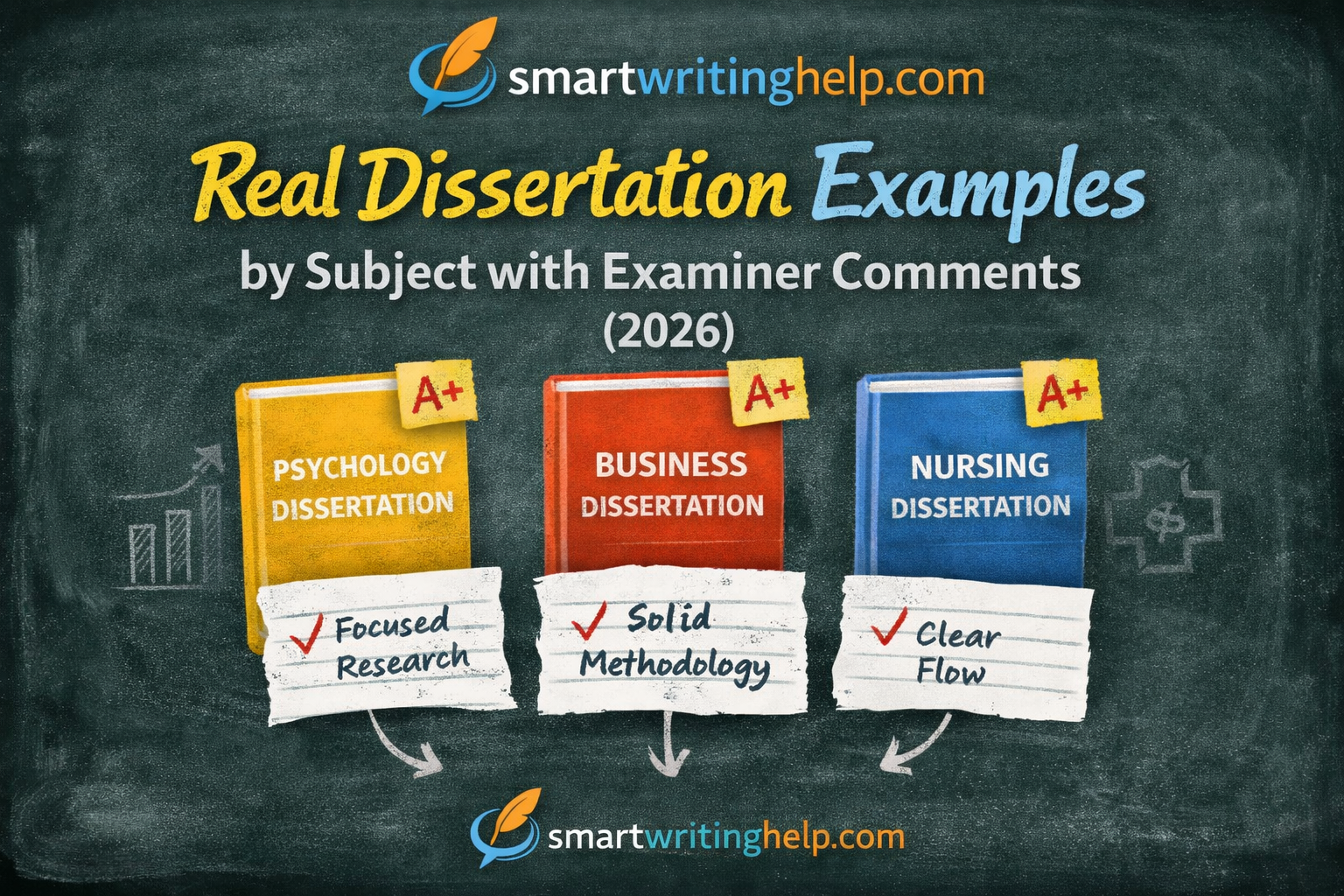
Real dissertation examples with examiner comments show that high-scoring work depends on clarity, structure, and strong justification.
Across all subjects, top dissertations have a focused research question, solid methodology, and clear flow. Following these proven standards is what separates average work from distinction-level results.